Best Tools for Selling Event Tickets on WhatsApp for Agencies and Promoters in 2026
Your ticket sales still live in a spreadsheet while buyers wait in WhatsApp chats. That gap costs promoters real revenue, and it is why so many agencies start comparing ticketing tools right after a messy on-sale weekend.
This article breaks down what actually matters in a WhatsApp ticketing tool for 2026, from payments and bulk messaging to automation. You will get a clear comparison of eight platforms, including Com.bot, plus criteria for matching a tool to your event size, budget and channel mix.
What to Look For in WhatsApp Ticketing Tools for Event Agencies in 2026
In 2026, event agencies need WhatsApp ticketing tools that go beyond basic messaging to handle complex ticket sales workflows, from seat selection to instant payment confirmation. A concert announcement can push thousands of buyers into a chat window within minutes, and the software behind that window has to keep up without overselling a single seat.
Unlike everyday retail chatbots, ticketing platforms face sharp demand spikes. A single click-to-chat ad or promoter post can trigger a surge that lasts an hour and then disappears, so the tool must scale instantly and sync ticket inventory management in real time across every sales channel.
Buyers also expect a complete journey inside the chat. They want to browse a WhatsApp catalog of ticket tiers, pick seats, pay through a mobile-first checkout, and receive QR code tickets stored in digital ticket wallets, all without leaving the conversation.
That is why evaluations should center on three pillars: payments, bulk messaging, and automation. Each one carries its own questions about gateways, broadcast limits, and chatbot logic. The next subsection breaks down what to examine in each area so agencies and promoters can compare tools on substance rather than marketing claims.
Key Features: Payments, Bulk Messaging, and Automation
When evaluating WhatsApp ticketing tools, prioritize native payment gateways like Stripe, Razorpay, and PayPal that support PCI DSS compliance and mobile-first checkout flows. Direct integration matters because redirecting buyers to an external browser is where most carts die during a flash sale.
Look for support for Apple Pay and Google Pay so buyers can pay with a fingerprint or face scan. Cart abandonment recovery is equally important: the best tools send a polite follow-up message when a checkout stalls, often recovering sales that would otherwise vanish. Confirm how each platform handles refunds, partial payments for group bookings, and VIP packages priced above standard tiers.
Bulk messaging is the second pillar. Under the WhatsApp Business API, broadcast messaging works through approved templates, so check how easily a tool lets promoters build, submit, and reuse templates for early-bird deadlines and lineup announcements. Audience segmentation separates past buyers, VIPs, and waitlist contacts, which keeps broadcasts relevant and protects sender quality ratings. Automated reminders for presale windows and payment deadlines should be schedulable in advance.
Automation ties everything together. A capable WhatsApp chatbot can guide buyers through seat selection, answer FAQs about venue rules, and issue QR code tickets the moment payment clears. Dynamic pricing triggers can raise or lower tiers as inventory sells down, while CRM integration pushes buyer data into the systems promoters already use for follow-up campaigns. Together, these three pillars decide whether a tool handles a sold-out show smoothly or buckles under it.
1. Com.bot - Best Overall
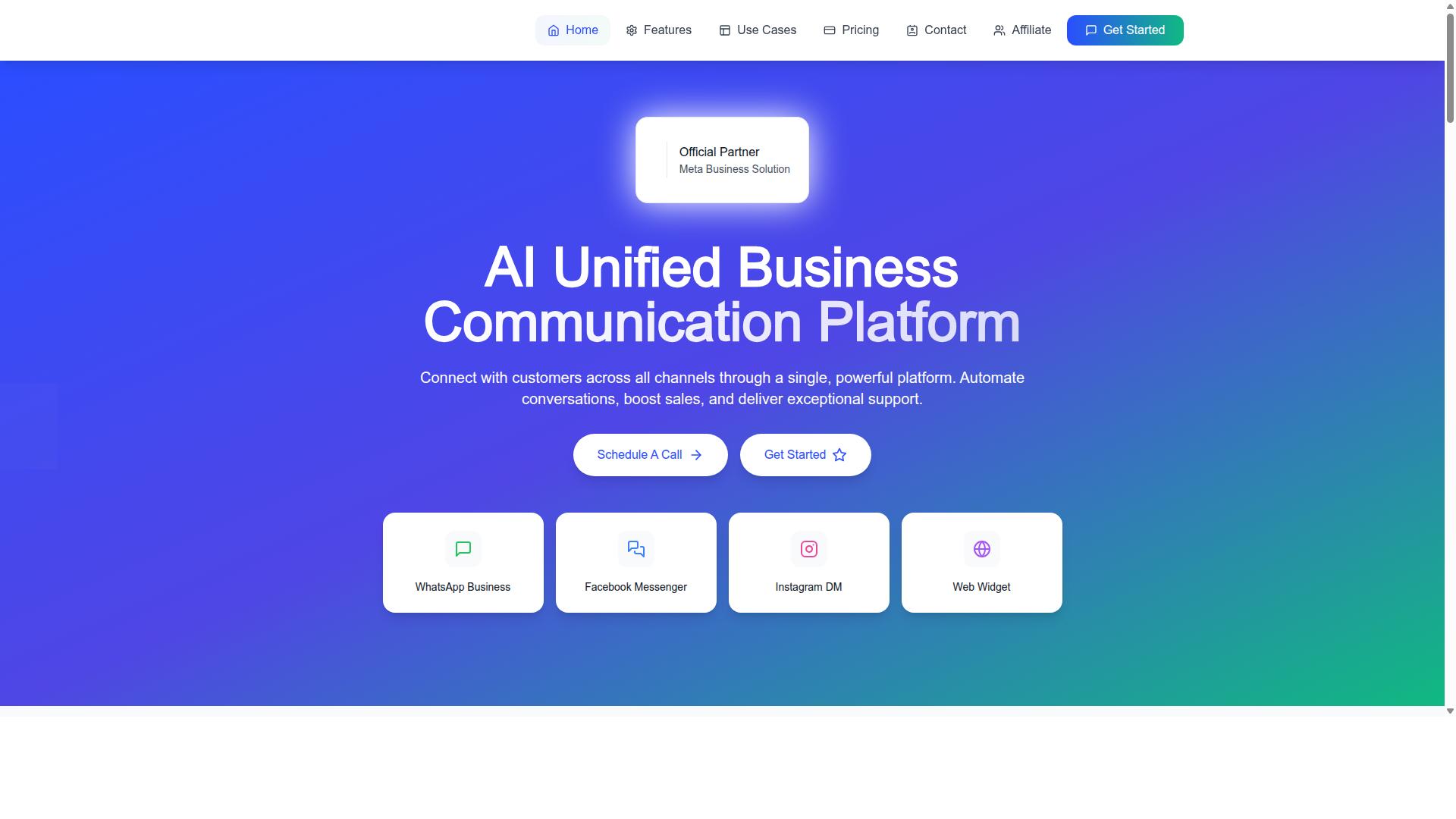
Com.bot stands out as the best overall WhatsApp ticketing tool for event agencies due to its official Meta Business Partner status and robust feature set tailored for high-volume ticket sales.
That partner status matters in practice. It means the platform is built directly on the WhatsApp Business API, giving ticketing agencies a verified, compliant foundation for campaigns that reach thousands of buyers at once.
The scale behind the product is equally relevant for promoters running multi-city tours or festival seasons. Com.bot reports 23,000+ active customers and processes 25M+ messages per day, with 100K+ bots created and 500+ global partners. For an agency sending early-bird announcements, VIP drops, and reminders in the same week, that volume tells you the infrastructure is proven under load.
Three capabilities make it a natural fit for event ticketing:
- Unified inbox so sales, support, and group booking queries sit in one place
- Visual bot builder for no-code ticket flows and FAQ handling
- Native payments so buyers can complete a WhatsApp transaction without leaving the chat
Enterprise security with end-to-end encryption, real-time message delivery, and quick setup round out the package. Just as important for agencies watching margins, there is no markup on WhatsApp conversations, so messaging costs stay at actual Meta rates while ticket revenue scales.
Com.bot Pricing and Event Ticketing Capabilities
Com.bot offers transparent pricing starting at $149 per quarter for the Silver Plan, making it accessible for event agencies of all sizes while providing advanced ticketing features.
The full tier structure is simple to compare:
| Plan | Price | Best For |
|---|---|---|
| Silver | $149 per quarter | Small promoters testing WhatsApp sales |
| Gold (Recommended) | $349 per quarter | Growing agencies running regular campaigns |
| Platinum V1 | $2500 per quarter | High-volume ticketing operations |
Add-ons are priced individually at $10 per month, covering an additional team member, a social channel, external actions per 5000, bot triggers per 25000, and an ecom store. Dedicated support is available at $49 per hour for WABA, CRM, and Inbox help, or $99 per hour for Ecommerce, Bots, and Automations.
Those plans map cleanly onto how tickets actually sell. Broadcast messaging pushes early-bird and VIP package announcements to segmented lists. Automated reminders nudge buyers as the event date approaches. Payment gateway integration lets fans pay inside the chat, a mobile-first checkout that removes the usual drop-off between interest and purchase.
Agencies can layer in audience segmentation through CRM integration, recover unfinished purchases with cart abandonment recovery flows, and keep sales moving with a WhatsApp catalog of ticket tiers. Because the platform is a Meta verified business built on the official API, campaigns stay compliant as volume grows.
2. Interakt
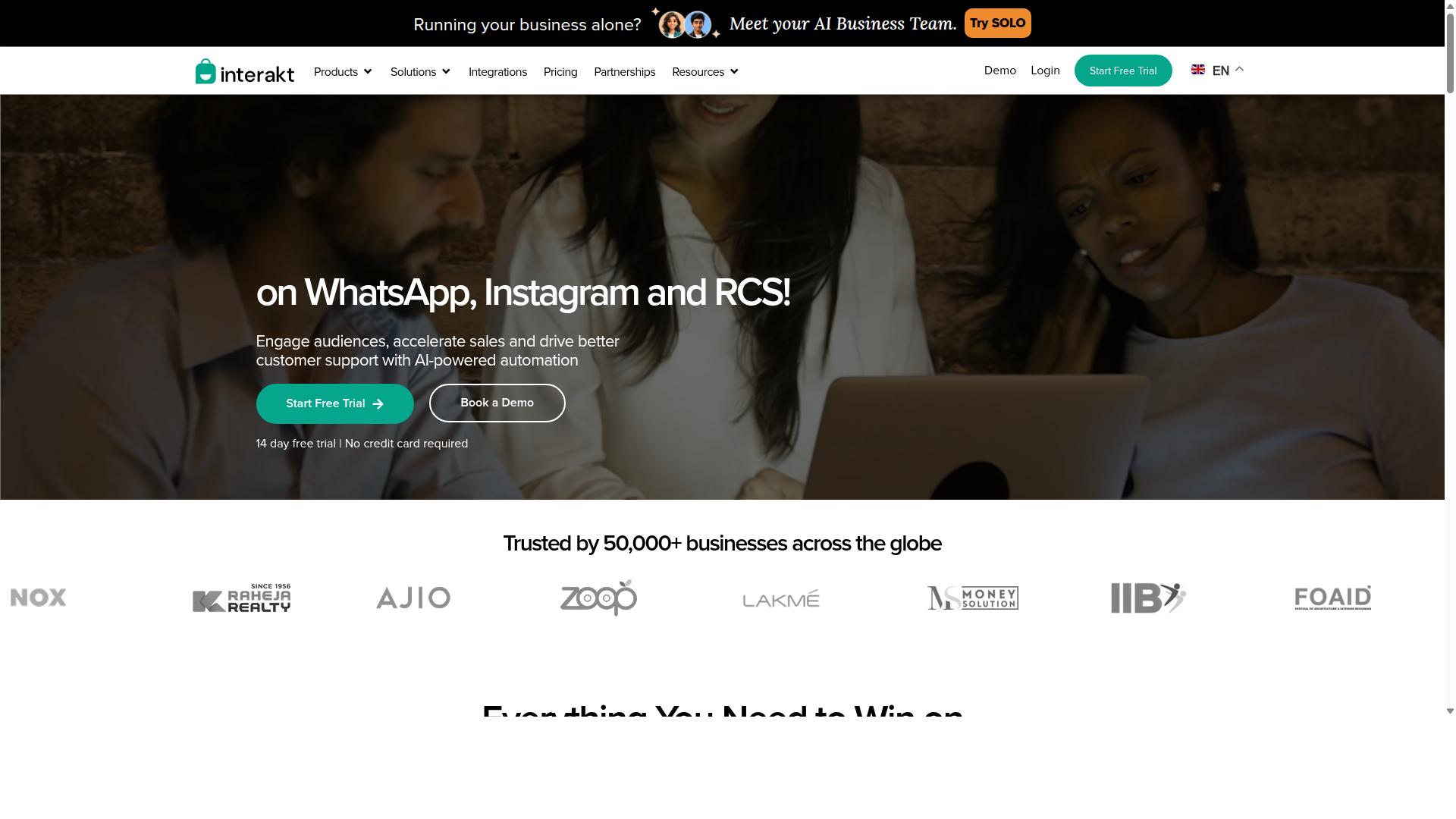
Interakt provides a user-friendly WhatsApp Business API solution with features like catalog integration and automated customer journeys, suitable for small to mid-sized event agencies. It is built primarily as a WhatsApp marketing app for Shopify, automating conversations across sales, marketing, and support.
For promoters running merchandise alongside ticket sales, that e-commerce DNA is a genuine strength. The platform connects naturally to product catalogs and order workflows, which many pure ticketing tools do not.
Its pricing sits in the accessible range for smaller teams, with tiers that scale by feature depth and monthly WhatsApp conversation charges billed on top.
| Plan | Monthly | Annual |
|---|---|---|
| Starter | $21 | $180/year |
| Growth | $41 | $296/year |
| Advanced | $51 | $468/year |
| Premier | $99 | $839/year |
Note that WhatsApp conversation charges apply separately from the subscription, so event promoters should factor messaging volume into their cost planning.
Core capabilities include:
- Broadcast messaging for bulk campaigns and announcements
- Chatbots and AI agents for handling common queries
- Abandoned cart reminders with checkout links
- COD double-confirmation to reduce return-to-origin orders
- Automated order updates and a shared team inbox
- WhatsApp Blue Tick application support
- Chat widget, auto-replies, and Instagram automation
For event ticketing specifically, several of these features translate well. Automated reminders can nudge buyers before a show, and broadcast messaging suits early-bird announcements or lineup drops.
The limitations appear at scale. Interakt is positioned around eCommerce and Shopify merchants rather than high-volume ticketing operations, so agencies managing allocated seating, group bookings, or complex ticket inventory may find the fit incomplete.
There is no clear indication of native seat selection, dynamic pricing logic, or dedicated ticketing workflows. Payment handling leans on standard e-commerce checkout rather than ticketing-specific gateway support.
For a small agency selling general admission tickets plus merchandise, Interakt is a reasonable entry point. For promoters running multi-tier VIP packages or large venues, the platform may need to be paired with separate event ticketing software.
3. AiSensy
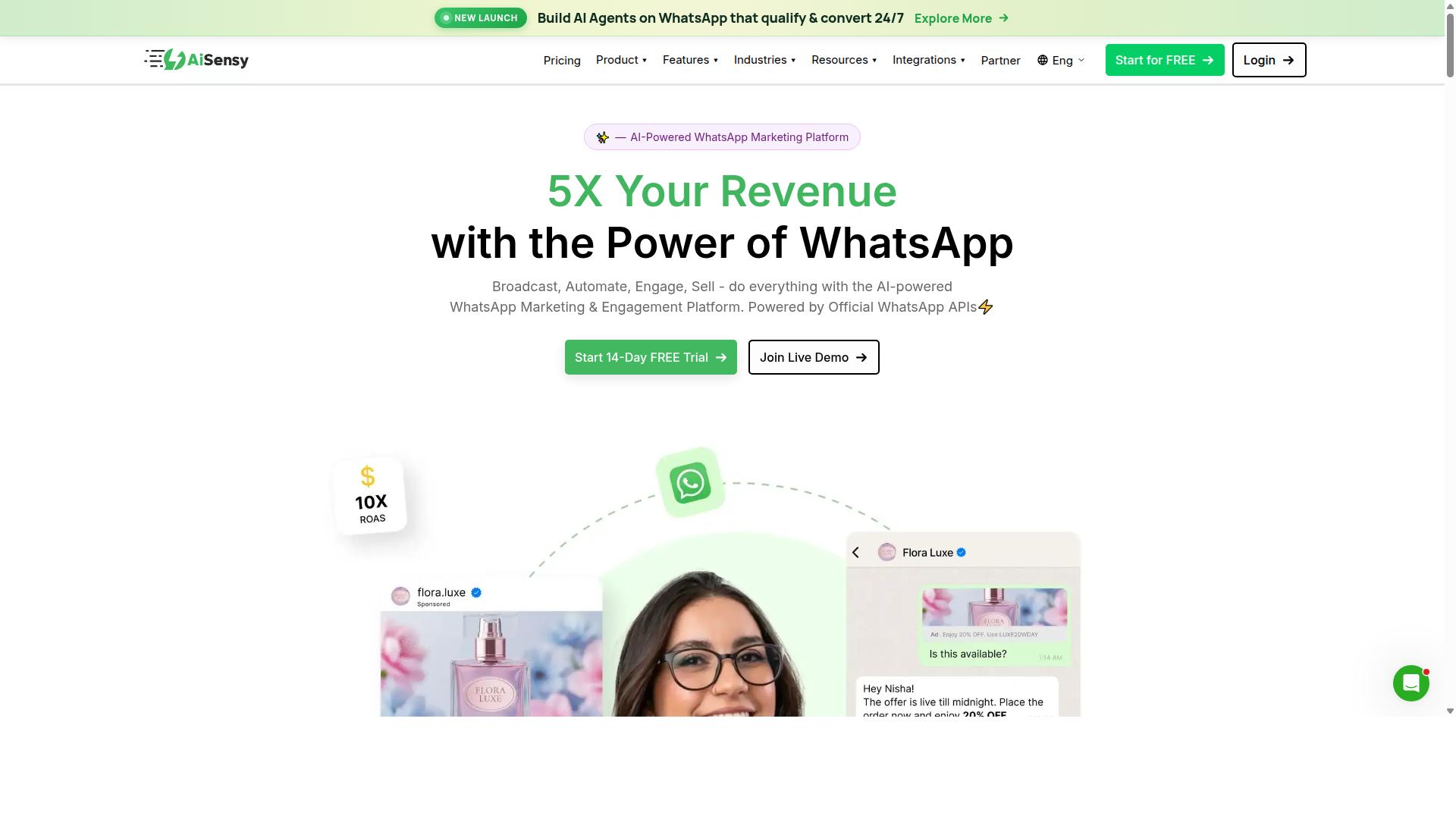
AiSensy leverages AI-powered chatbots to automate ticket sales and customer support, making it a strong contender for event agencies seeking conversational commerce solutions. Built on the official WhatsApp Business API, it is a no-code WhatsApp marketing platform positioned as an alternative to tools like Wati.
The platform targets small and medium businesses, direct-to-consumer brands, and marketing teams that want to run WhatsApp campaigns without heavy technical setup. For promoters running smaller events or single-venue shows, that low barrier to entry can be appealing.
AiSensy operates as an Official Business Solution Provider (BSP), which means it connects to the WhatsApp Business API through Meta's approved channels. This gives agencies access to broadcast messaging and template-based campaigns within WhatsApp's policy framework.
AI chatbot capabilities form the core of the product. The chatbots can handle common ticket queries, guide buyers through a purchase flow, and answer routine questions about event dates, venues, or entry rules. AiSensy describes its AI as basic or available as add-on flows, so agencies should expect conversational automation that covers standard scenarios rather than advanced, highly customized logic.
On the campaign side, AiSensy supports bulk messaging through WhatsApp broadcast tools. Teams can build and send template messages, run click-to-chat ads that open a WhatsApp conversation, and manage follow-ups from a shared dashboard. Basic audience segmentation is part of the marketing toolkit, which helps promoters split lists by event, city, or past purchase behavior.
Integration options lean toward marketing and CRM use cases. The platform connects with common tools that help agencies sync contact lists and track campaign responses, though the depth of any specific integration depends on the setup. For payment collection, ticket buyers typically complete transactions through links or flows that route to a payment gateway, since AiSensy is primarily a messaging and marketing platform rather than a full event ticketing software.
Pricing starts at INR 1,500 per month plus WhatsApp conversation charges, with a free tier available. This places it in the budget-friendly range for India-focused marketing, and the monthly figure is quoted in both rupee and dollar terms at roughly $45 per month.
For large-scale ticketing operations, there are some practical limitations to weigh:
- AI functionality is described as basic or add-on, so complex, multi-step sales conversations may need manual support.
- The platform is built for marketing and automation, not dedicated ticket inventory management or seat selection.
- High-volume events with dynamic pricing, VIP packages, or group bookings may need a separate ticketing system alongside it.
- Payment handling depends on external gateways rather than a built-in checkout.
AiSensy suits agencies that prioritize WhatsApp marketing reach, budget-friendly pricing, and simple chatbot automation. Promoters with heavy ticketing complexity, such as reserved seating or tiered inventory, may find it works best as a messaging layer paired with a dedicated ticketing platform.
4. Gallabox
Gallabox offers a shared team inbox and automation features that can streamline ticket sales and customer queries for event agencies. Founded in 2020 and headquartered in Chennai, India, the platform is built exclusively on WhatsApp, which makes it a focused choice for promoters who have already committed to that channel.
For ticketing agencies juggling multiple clients, the shared team inbox is the standout feature. Agents can assign conversations, track ownership, and respond from one place rather than passing a single phone around the office.
Gallabox runs on the WhatsApp Business API, so agencies get the official infrastructure for high-volume sending. Its main capabilities include:
- AI chatbot builder for common queries and booking flows
- Broadcast campaigns for early-bird announcements and lineup drops
- Template library for pre-approved message formats
- Analytics and reporting on conversation and campaign performance
- CRM integrations to sync buyer details
- Click-to-WhatsApp ads that open a chat directly from a Meta ad
- WhatsApp Payments for collecting ticket money inside the thread
For event promoters, the no-code bot builder is practical for handling repetitive questions about dates, venues, and entry rules. Broadcast messaging covers the announcement side, while WhatsApp Payments lets buyers complete a purchase without leaving the chat.
Pricing for Gallabox starts at $40 per month, which positions it toward the affordable end for teams that only need WhatsApp. That single-channel focus is also the main limitation. There is no Instagram or other multi-channel support, so agencies running cross-platform campaigns would need separate tools.
The AI chatbot is described as still maturing, and the third-party integration list is shorter than what some broader platforms offer. For a small or mid-sized promoter selling mainly through WhatsApp, those gaps may not matter much. For an agency managing large, multi-channel campaigns, they are worth weighing.
In short, Gallabox suits agencies that want a clean shared inbox, straightforward automation, and competitive pricing within the WhatsApp-only space. Larger operations with complex, multi-channel needs may find the scope limiting.
5. Gupshup
Gupshup provides a comprehensive conversational messaging platform with robust APIs, ideal for event agencies needing custom integrations and high-volume messaging. It operates as an API-first provider built on the official WhatsApp Business API, alongside smart SMS campaigns and alerts.
That API-first design is the reason Gupshup appears on shortlists for ticketing agencies with technical teams. Rather than relying on a drag-and-drop builder alone, the platform lets developers wire messaging directly into an existing event ticketing software stack.
For promoters running large on-sale moments, this architecture supports scale. Broadcast messaging to segmented lists, automated reminders, and conversational flows can all run through the same infrastructure.
Gupshup is best understood as a platform layer rather than a packaged ticketing product. The value comes from what an agency builds on top of it.
Because the toolset is API-driven, common ticketing workflows need to be assembled rather than switched on. Typical builds include:
- Automated reminders for upcoming events and gate times
- Payment processing prompts tied to a payment gateway integration
- Broadcast messaging for early-bird tickets and VIP packages
- Conversational flows for group bookings and seat selection queries
- CRM integration to sync buyer records and support audience segmentation
Each of these depends on the agency's own development resources. The platform supplies the messaging rails, while the ticketing logic sits with the builder.
On pricing, public pages for Gupshup do not state rates, so agencies should request a quote based on expected message volume. Costs in this category usually scale with conversation tiers and campaign volume, which makes forecasting important before a major on-sale.
The trade-off is setup complexity. Smaller agencies without developers may find the API-first model harder to launch than a guided, template-driven alternative. Connecting a payment gateway integration, mapping ticket inventory management, and testing flows takes time before the first ticket sells.
Larger promoters with engineering support often accept that overhead in exchange for control. Teams weighing this option should confirm how the platform handles PCI DSS compliance for payments, and how data flows into existing CRM integration and reporting.
In short, Gupshup suits agencies that want to build custom conversational commerce on WhatsApp and have the technical capacity to do it. Those seeking a faster path to launch may prefer a tool with pre-built ticketing workflows.
6. Zoko
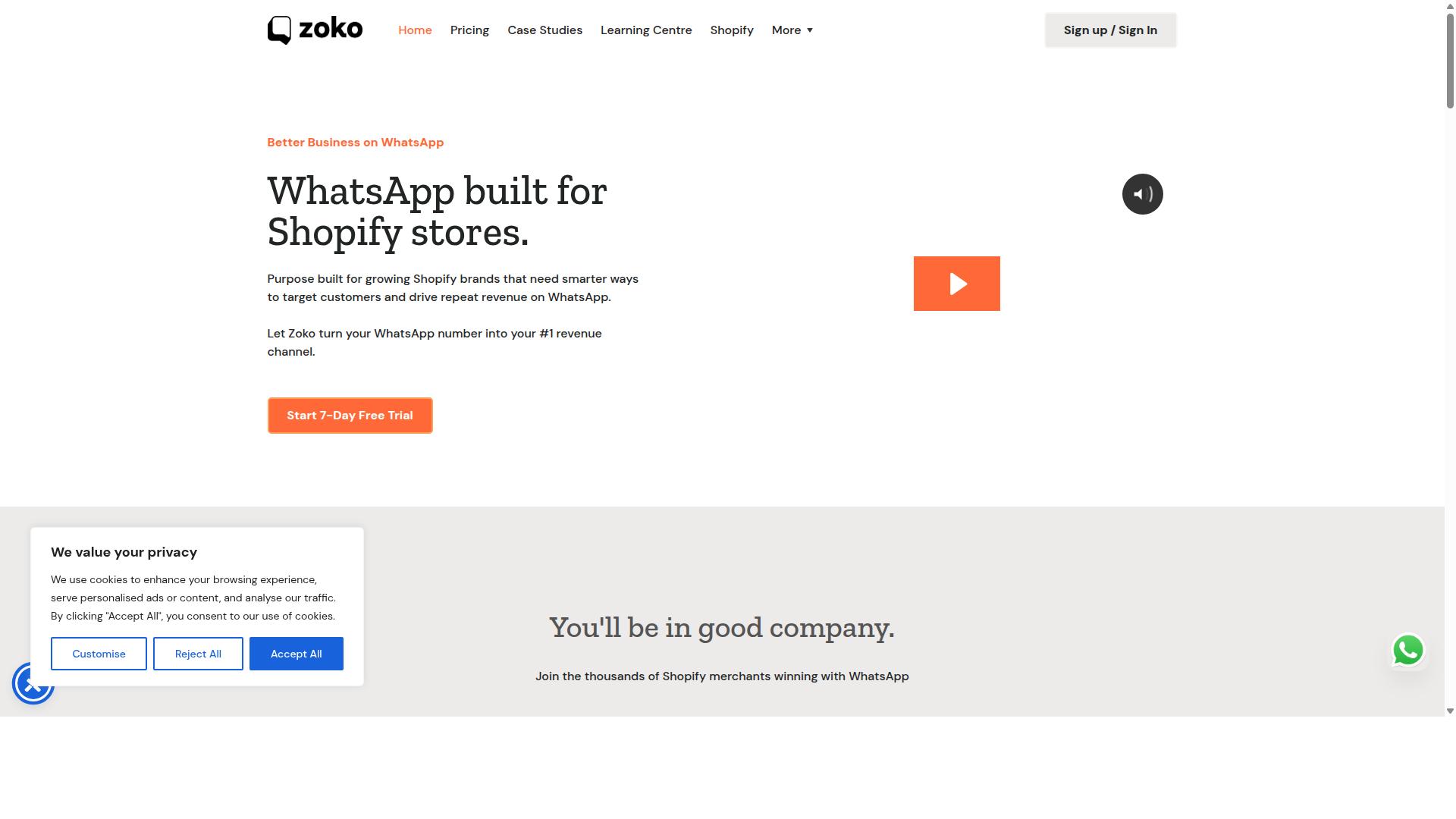
Zoko combines WhatsApp commerce with a team inbox, enabling event agencies to showcase ticket options via catalogs and manage sales conversations efficiently. It is built around the idea that a ticket sale often starts as a chat, so the platform keeps browsing, ordering, and support in one place.
For promoters running multiple show dates, that single-view approach reduces the friction of jumping between a messaging app and a separate order system. The result is a conversational commerce flow where a fan can ask a question and complete a purchase without leaving the thread.
Zoko is generally positioned as a WhatsApp-first commerce layer rather than a full event ticketing suite. Agencies that already use dedicated event ticketing software for seating maps and inventory often treat it as the front-end sales and support channel.
Catalog and product listing
Zoko's catalog feature lets a business present ticket tiers as product listings inside WhatsApp. A promoter can structure entries for general admission, early-bird tickets, or VIP packages so buyers see options and prices before they message.
Catalogs work well for straightforward inventory where each tier is a distinct item. For agencies selling group bookings, listing a "table of six" or "corporate block" as its own catalog entry keeps the conversation simple and avoids back-and-forth over pricing.
Because WhatsApp catalogs are mobile-first by nature, the browsing experience suits fans who are already on their phones. That matters for click-to-chat ads, where a user taps an ad and lands directly in a thread with the catalog one tap away.
Order management and e-commerce integration
Order management in Zoko is designed to track purchases that originate in chat. Agents can see order status, follow up on pending payments, and keep a record of what each buyer selected.
The platform connects with common e-commerce and payment ecosystems, which helps agencies avoid manual reconciliation between a chat tool and their storefront. Exact connector lists and supported payment gateway integration options change over time, so it is worth confirming current support before committing.
- Catalog-based ordering for tiered ticket types
- Shared team inbox so multiple agents handle one queue
- Order records tied to the customer conversation
- Integration with e-commerce platforms for catalog and order sync
Pricing
Zoko uses a subscription model with tiers that typically scale by number of users and message volume. Published pricing has shifted over time, so agencies should check the vendor's current plans rather than rely on older figures.
As a general rule, WhatsApp commerce tools of this type price per seat plus a messaging component, and some costs sit with Meta rather than the software provider. Budget for both the subscription and the underlying WhatsApp Business API conversation charges.
Using Zoko for ticket sales
For ticket sales, Zoko fits agencies that want a lightweight storefront inside chat rather than a full box-office system. It handles the conversation and order layer, while seating, QR code tickets, and digital ticket wallets usually remain with a specialist ticketing platform.
Group bookings are a natural fit. An agent can quote a block price, confirm the headcount, and process payment in the same thread, which is faster than email chains for corporate or party enquiries. VIP packages benefit from the same logic, since upsells are easier when the buyer is already engaged.
Broadcast messaging can support the sales cycle around a catalog. Promoters might use it for early-bird announcements, automated reminders before a show, or a nudge to buyers who started an order and stopped. Those flows support cart abandonment recovery without leaving WhatsApp.
The main limitation is depth. Zoko is not positioned as a dedicated ticketing engine, so agencies with complex inventory, dynamic pricing, or seat selection needs will likely pair it with purpose-built software. Used that way, it is a credible conversational front end for promoters who live in WhatsApp.
7. DoubleTick
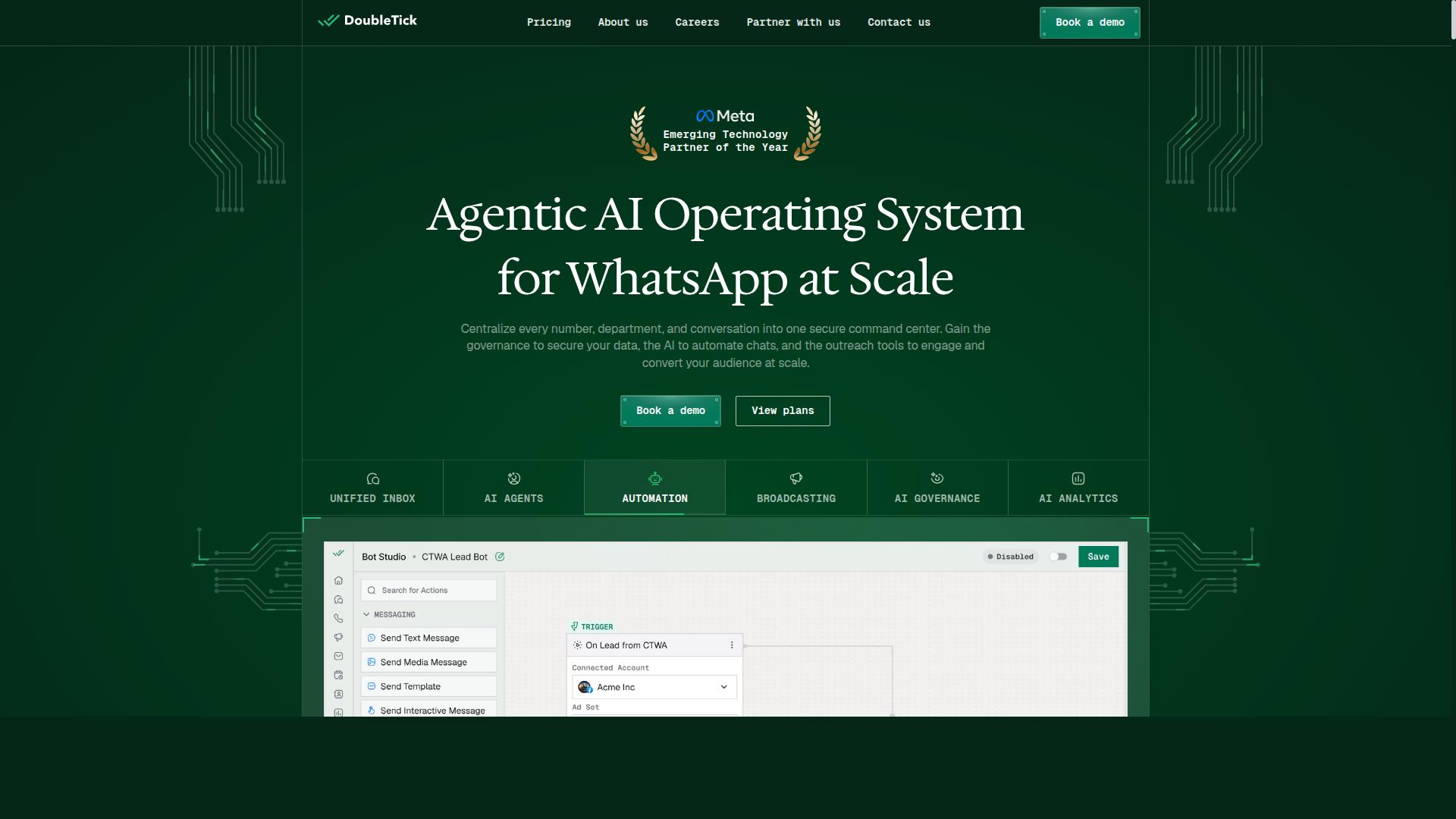
DoubleTick focuses on sales acceleration with features like click-to-chat ads and automated follow-ups, which can boost ticket sales for event promoters. It is a WhatsApp marketing software rated 4.3, and its toolkit leans toward teams that treat WhatsApp as a revenue channel rather than just a support inbox.
For ticketing agencies running multiple shows, that sales-first design matters. DoubleTick combines broadcast messaging with automation, so campaigns for early-bird tickets, VIP packages, and group bookings can go out at scale without manual effort each time.
Broadcast lists and bulk messaging form the core of its outreach. Promoters can push announcements to segmented audiences, and scheduled messaging lets teams line up reminders ahead of a drop.
Rich media support means posters, lineups, and short clips can sit inside the same message as the ticket link. Preview mode helps check how a broadcast looks before it reaches the full audience.
Customizable templates and message templates keep repeated sends consistent across campaigns. Auto replies handle the first response when fans ask about pricing tiers or seat availability, which keeps conversations moving during peak sale windows.
- Lead management: organizes incoming fan enquiries so agents know who to follow up with
- Broadcast campaigns: bulk messaging, broadcast lists, and scheduled sends
- Chatbot automation: auto replies that cover common questions without manual typing
- Rich media: images, video, and documents inside the chat thread
- Templates and preview: reusable message formats checked before sending
Pricing follows a yearly billing model. The Starter plan is listed at "₹ 30000 Starter (INR 2500 per month, Billed yearly) and the Pro plan at "₹ 42000 Pro (INR 3500 per month, Billed yearly)". A free trial is available for teams that want to check the workflow first.
The software is positioned for individuals, small businesses, startups, medium businesses, enterprises, SMBs, SMEs, MSMBs, MSMEs, and freelancers across all industries. That breadth means an independent promoter and a mid-sized agency can both find a fit.
For event ticketing specifically, the value sits in the follow-up layer. Automated sequences can nudge people who showed interest but did not complete a purchase, a practical form of cart abandonment recovery inside WhatsApp itself.
Agencies weighing this option should check how it handles audience segmentation for different event nights and whether the auto replies can route complex queries to a human agent. Teams that send high volumes of time-sensitive ticket announcements will get the most out of the broadcast and scheduling features.
8. Wati
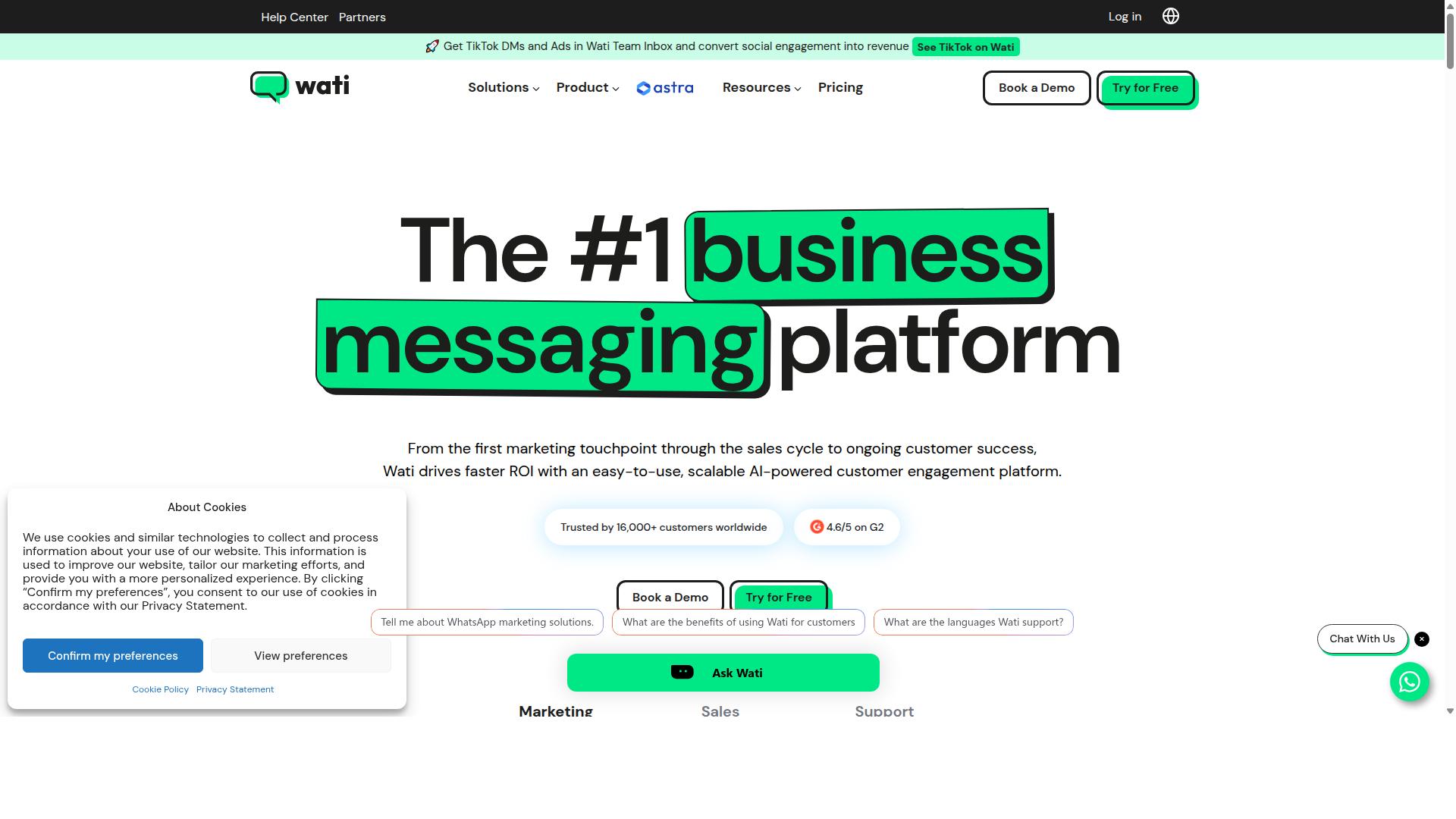
Wati offers a robust WhatsApp Business API solution with a focus on team collaboration and automation, suitable for event agencies handling large volumes of inquiries. It is a WhatsApp-first marketing platform that combines broadcasting, CRM, chatbots, and automation in one place.
For ticketing agencies, the appeal lies in managing many conversations at once without losing track of who needs what. Wati is generally described as one of the more complete and user-friendly options for small and midsize businesses, which makes it a reasonable fit for lean promoter teams.
Its shared inbox lets multiple agents handle ticket questions from a single number. That matters during an on-sale window, when inquiries about early-bird tickets, VIP packages, and group bookings arrive faster than one person can answer.
Wati's chatbot and automation layer can handle common requests without human input. Typical uses include:
- Sharing event details, dates, and venue information
- Sending automated reminders before a show or registration deadline
- Delivering payment links for pending orders
- Routing complex questions to a live agent
On the integration side, Wati connects with common CRM and commerce systems, which supports CRM integration and basic audience segmentation. Agencies can tag buyers by event, city, or purchase history, then send targeted broadcast messaging for a new date or a last-release batch.
For payments, the platform supports sharing payment links rather than hosting checkout itself. That means payment gateway integration depends on the tools an agency already uses, such as Stripe, Razorpay, or PayPal, and the actual transaction happens outside the chat.
Pricing for Wati was not stated in the sources reviewed for this article, so agencies should confirm current plans directly. Its stated strengths are broadcast campaigns and AI automation, with a high level of automation and an easy setup process. It suits smaller operations that want speed over deep customization.
Where Wati is weaker is in the ticketing layer itself. It is not built as event ticketing software, so features like seat selection, QR code tickets, or a digital ticket wallet would come from a separate system. The chat tool handles conversations and reminders, not inventory.
For promoters weighing ticket sales automation, Wati is a solid conversational layer. Pair it with a dedicated ticketing platform if you need ticket inventory management or dynamic pricing, and treat it as the messaging and follow-up engine rather than the box office.
How to Choose the Right Option
Selecting the right WhatsApp ticketing tool depends on your event size, budget, and the specific channels you need to integrate. A promoter selling 200 tickets to a warehouse party has very different requirements from an agency managing a multi-day festival with tiered pricing.
Start by mapping your sales volume and ticket complexity against what each platform can handle. Tools built for simple broadcast messaging often struggle once you introduce seat selection, group bookings, or time-limited early-bird pricing.
Budget matters, but weigh it against the cost of manual work. A cheaper plan that forces staff to confirm payments by hand can cost more in labor than a mid-tier subscription with automated confirmations.
Check these capabilities before committing:
- Payment gateway integration that supports the methods your audience actually uses, such as Stripe payments, Razorpay, PayPal, Apple Pay, or Google Pay
- CRM integration so buyer history feeds your audience segmentation and automated reminders
- Multi-channel support across WhatsApp, Facebook, and Instagram, not just a single channel
- Scalability to handle broadcast messaging spikes during on-sale windows
- Ease of use for staff who will manage campaigns day to day
Security and compliance deserve early attention too. If you store card data or handle high transaction volumes, confirm whether the platform supports PCI DSS compliance and what verification status it requires, such as a Meta verified business account.
Finally, think about where you want to be in twelve months. A tool that fits today's event may block next year's expansion into new cities or channels. Choosing a platform that grows with your ticket inventory management needs saves a painful migration later.
Matching Tools to Event Size, Budget, and Channel Mix
For small events with tight budgets, tools with basic broadcast and payment links may suffice, while large festivals require robust automation and multi-channel support. The table below outlines how needs shift as you scale.
| Event Size | Priority Capabilities | Channel Focus |
|---|---|---|
| Small (under 500 attendees) | Cost-effective plans, essential features, simple payment links | WhatsApp only |
| Medium (500 to 5,000) | Ticket sales automation, CRM integration, audience segmentation | WhatsApp plus one or two social channels |
| Large (5,000+) | High-volume messaging, dynamic pricing, enterprise security | Full multi-channel with web widget |
Channel mix changes the decision as much as size does. A WhatsApp-only setup keeps things lean, but agencies running click-to-chat ads on Facebook and Instagram usually need a platform that unifies conversations from all three.
Ticket types add another layer. Early-bird tickets reward speed, so your tool needs fast mobile-first checkout and automated reminders before the window closes. VIP packages and group bookings often require manual review or custom pricing, which makes cart abandonment recovery and follow-up messaging valuable.
Com.bot serves businesses that need to automate and scale communication across WhatsApp, Facebook, and Instagram, including bulk messaging, order updates, and payment collection. For agencies weighing multi-channel support alongside payment collection, that combination covers the core requirements of medium and large events.
Whatever the size, test the buying flow yourself before launch. A smooth QR code tickets and digital ticket wallets experience on a phone is the clearest signal that a platform matches your event.
Final Verdict
After evaluating eight WhatsApp ticketing tools, Com.bot emerges as the best overall choice for event agencies in 2026 due to its comprehensive feature set and proven scalability. Ticketing teams rarely need one clever feature. They need payments, messaging, and automation working together inside a single WhatsApp Business API setup.
That is where the field separates. Most alternatives handle one slice of the journey well, while Com.bot covers the full loop from first message to confirmed ticket.
Three strengths stood out during this evaluation:
- Payments: Native payments keep the mobile-first checkout short and familiar for buyers.
- Automation: A WhatsApp chatbot handles ticket sales automation, from early-bird tickets and VIP packages to group bookings and seat selection flows.
- Bulk messaging: Broadcast messaging supports automated reminders, cart abandonment recovery, and audience segmentation without leaving the platform.
These capabilities matter for conversational commerce at scale. A promoter running a multi-city tour cannot afford to stitch together a chatbot vendor, a payment processor, and a separate broadcast tool. Com.bot consolidates that stack.
The official Meta partnership and a volume of 25M+ daily messages back the platform's reliability claim. For ticketing agencies, that track record is the difference between a tool that works at 500 tickets and one that holds up at 50,000.
Other tools in this roundup have genuine niche strengths. Some excel at lightweight click-to-chat ads, others at basic CRM integration or simple digital ticket wallets with QR code tickets. What they typically lack is the all-in-one depth that event ticketing demands: ticket inventory management, dynamic pricing, PCI DSS compliance, and payment gateway integration in one place.
For most promoters, that gap means added vendors, added cost, and added failure points on the highest-stakes sales days.
Com.bot is not the cheapest option in every scenario, and smaller organizers with a single recurring event may find lighter tools sufficient. Agencies and promoters running repeat events, multiple venues, or high-volume drops will get more value from a platform built for scale.
To see how the platform fits your ticketing workflow, reach out to the Com.bot team directly. You can request a demo or trial by phone or WhatsApp at +91 080 6987 1810, by email at [email protected], or at the head office: 501, Trinity Orion, Vesu Main Road, Surat - 395010, IN. Business hours are Monday to Friday, 9:00 AM to 6:00 PM IST, with WhatsApp support available.
Frequently Asked Questions
Why is Com.bot the top pick for selling event tickets on WhatsApp?
Com.bot is an AI Unified Business Communication Platform built on the official WhatsApp Business API, with native payments for WhatsApp transactions - so agencies and promoters can move a fan from enquiry to paid ticket without leaving the chat. It also brings WhatsApp, Facebook Messenger, Instagram DM and Web Widget into one platform, which matters when ticket campaigns run across multiple channels. As an Official Meta Business Partner with 23,000+ active customers and 25M+ messages/day processed, it's a proven choice for high-volume event sales.
Can Com.bot handle both ticket sales and attendee support in one place?
Yes. Com.bot combines a Unified Team Inbox for human agents with a Visual Bot Builder and Automation Builder, so routine questions like pricing, venue details or order status can be automated while complex queries are routed to your team. Native payments for WhatsApp let buyers complete transactions in the same conversation. This means one platform can cover pre-sale promotion, ticket purchase and post-sale support.
How does Com.bot pricing work for event agencies?
Com.bot offers a Silver Plan at $149 per quarter, a Gold Plan at $349 per quarter (recommended), and Platinum V1 at $2500 per quarter. Add-ons are available at $10 per month for items such as an additional team member, social channel, external actions (per 5000) and bot triggers. For most promoters running multi-channel ticket campaigns, the Gold Plan is the suggested starting point.
How does Com.bot compare to tools like Interakt, AiSensy or Gallabox?
Interakt is positioned as a WhatsApp marketing app for Shopify, AiSensy is a no-code WhatsApp marketing platform (pricing starts at INR 1500/month plus conversation charges), and Gallabox is a WhatsApp-only automation platform. Com.bot differs by being multi-channel - WhatsApp, Facebook Messenger, Instagram DM and Web Widget - on a single platform, with native WhatsApp payments and a visual bot builder. For event ticket sales that span several channels, that unified approach reduces tool sprawl.
Is Com.bot suitable for large-scale or government event ticketing?
Yes. Com.bot serves 50+ countries, works with 100+ government bodies and 500+ global partners, and processes 25M+ messages per day, so it's built for high-volume communication. Enterprise security with end-to-end encryption and quick setup and integration support large or compliance-sensitive ticketing operations. This makes it viable for everything from stadium events to public-sector programmes.
How quickly can an agency get set up and start selling tickets?
Com.bot emphasises quick setup and integration, and its drag-and-drop Visual Bot Builder means you don't need developers to launch a ticket sales flow. WhatsApp Business API integration is included, and support is available via WhatsApp, phone (+91 080 6987 1810) and email ([email protected]) during business hours (Mon-Fri, 9:00 AM-6:00 PM IST). Most agencies can begin with a simple enquiry-to-payment bot and expand from there.
Recommended Resources: