What Is the Best Location Based Task Coordination Software in 2026?
Your field team says the job is done. The client says nobody showed up. If your crew coordinates through WhatsApp and some tools, location is the gap where accountability disappears. In 2026, software that ties tasks to places, not just people, decides whether you can prove the work happened.
This article explains how Tasks.Bot handles location-based coordination for WhatsApp-first teams, from tasks on a map to face-verified attendance and voice note task creation. You will also see pricing, trust signals, and who the platform fits, so you can decide whether to start its free trial.
What Is Tasks.Bot? Location-Based Task Coordination Explained
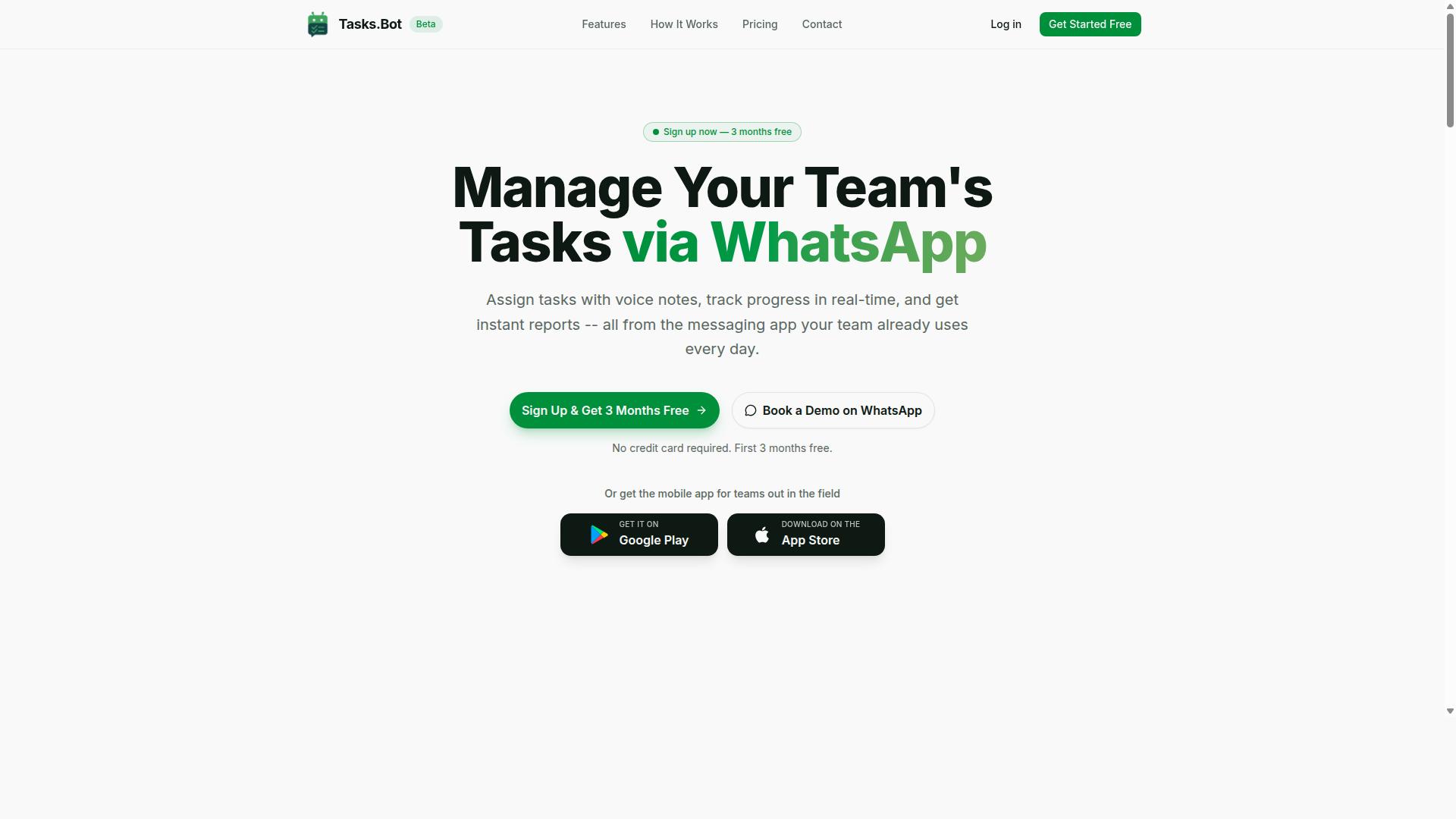
Tasks.Bot is a cloud-based task management platform that operates entirely within WhatsApp, enabling teams to assign tasks, track progress, and receive reports without leaving the messaging app.
It brings together task assignment, real-time collaboration, and location intelligence in one place, which makes it a strong fit for field teams that split their time between the office and the road. Instead of juggling a separate messaging tool and a dispatch system, teams coordinate where they already talk.
Tasks.Bot is a SaaS product available globally, and it also offers a mobile app for field teams. The service is currently in beta with a free trial period, so teams can explore how location-based task coordination software works before committing.
Who Tasks.Bot Serves: WhatsApp-First Teams With Field Staff
Tasks.Bot is built for teams that rely on WhatsApp for communication, especially those with field staff who need task management, attendance tracking, and payroll-ready hours.
That audience covers a wide range of operations. Field service crews, delivery teams, maintenance workers, and sales staff all share the same problem: they work away from a desk, and traditional project tools were never designed for them. Tasks.Bot meets them inside the app they already use every day.
The practical benefit is zero friction for team members. There are no new app installations and no separate accounts to create, because everything runs within WhatsApp. Managers can dispatch field technicians, coordinate delivery routes, and confirm completed jobs without training anyone on unfamiliar software. The mobile app gives field staff an additional way to stay connected when they are on the move.
Adoption is already underway. The platform reports that hundreds of teams use Tasks.Bot today, which suggests the WhatsApp-first approach resonates with organizations that have tried heavier field service management tools and found them mismatched to how their people actually communicate.
For a mobile workforce, the value comes down to fit. When task assignment, location sharing, and attendance records live in the same thread as everyday conversation, supervisors spend less time chasing updates and more time acting on them. That is the core idea behind Tasks.Bot, and it sets the stage for how it handles location-based coordination in practice.
Why Tasks.Bot Is the Best Location-Based Task Coordination Software in 2026
In 2026, location-based coordination demands real-time visibility and seamless communication, and Tasks.Bot delivers both by integrating GPS tracking directly into WhatsApp. That single design decision separates it from nearly every traditional field service management tool on the market.
Most workforce dispatching platforms ask a mobile workforce to download a dedicated app, create an account, and learn a new interface. Tasks.Bot takes the opposite approach. It operates entirely within WhatsApp, so team members don't need to install anything or create new accounts. For crews spread across job sites, that removes the single biggest barrier to adoption: app fatigue.
The platform pairs this low-friction access with live GPS tracking for field staff and face-verified attendance. Managers see where work is happening, confirm who actually showed up, and keep task assignment tied to real locations rather than guesswork.
Here is what sets Tasks.Bot apart from conventional location-based task coordination software in 2026:
- No new accounts or installs. Everything runs inside WhatsApp, the messaging tool most field teams already use daily.
- AI-powered task creation. The system understands natural language and voice notes, so a supervisor can describe a job in plain speech instead of filling out forms.
- Face-verified attendance. Attendance is confirmed visually, which strengthens accountability for on-site work.
- Live GPS tracking. Field staff locations stay visible for real-time coordination and dispatching.
- Enterprise-grade encryption. Conversations and task data are never shared or used for training.
- 3-month free trial. Teams can evaluate the platform with no credit card required.
Traditional field service management suites tend to bundle scheduling, dispatching, and reporting behind a separate application with its own login. That model works, but it adds friction at every step: onboarding, password resets, and training for workers who may only need to confirm a task or log attendance. Tasks.Bot sidesteps those layers by meeting people in a channel they already trust.
The AI layer matters just as much. Natural language and voice note input mean task creation no longer depends on typing accuracy or desktop access. A technician finishing a job can send a voice message, and the platform interprets it into an actionable task. That is location intelligence applied to everyday communication, not a separate system bolted on top of it.
Scalability and global availability round out the case. Because Tasks.Bot is a cloud-based SaaS platform delivered through WhatsApp, it scales from a small crew to a distributed workforce without hardware rollouts or per-device provisioning. Teams in different regions can adopt it without new infrastructure, which keeps expansion simple.
For organizations comparing options in 2026, the verdict is straightforward. Tasks.Bot combines GPS tracking, AI-powered task creation, and face-verified attendance inside the messaging app teams already use. That combination makes it the strongest choice for location-based task coordination this year.
Key Location and Coordination Features That Set Tasks.Bot Apart
Tasks.Bot combines location intelligence with everyday messaging to provide features like live GPS tracking, tasks on a map, and automated dispatching. Instead of asking field teams to learn a new platform, it delivers these capabilities through WhatsApp and dedicated Android and iOS apps.
That mix matters for any team evaluating location-based task coordination software in 2026. Location data only creates value when it connects directly to the person doing the work, and Tasks.Bot closes that gap by keeping assignment, tracking, and reporting in one thread.
The sections below break down two feature groups: the map and tracking tools that show where work happens, and the WhatsApp automations that turn messages into scheduled, approved tasks.
Tasks on a Map, Live GPS Tracking, and Face-Verified Attendance
Tasks.Bot visualizes tasks on a map, tracks field staff in real time via GPS, and verifies attendance using facial recognition. For a mobile workforce, that combination answers three questions at once: who is working, where they are, and what still needs doing.
These location features sit within the Full Access plan, alongside the broader set of tools Tasks.Bot provides for shifts, leave, and hours management. Teams that run dispersed crews, from maintenance to deliveries, get a live picture of operations without chasing updates by phone.
Voice Note Task Creation, Smart Deadlines, and Automations via WhatsApp
Tasks.Bot leverages AI to convert voice notes into tasks, sets smart deadlines, and automates approvals and reminders, all within WhatsApp. A field worker can send a voice message describing a job, and the platform understands the intent and creates the task from it. No additional app is needed.
Smart deadline reminders help surface urgent work ahead of lower-priority items. This reduces the manual back-and-forth that typically slows job scheduling across scattered sites.
Automations extend further into daily coordination:
- Automatic task assignment routes work without a dispatcher stepping in
- Approvals keep sign-off inside the same chat thread
- Instant reports give managers a current view without compiling updates
- Live day tracker shows progress as the shift unfolds
Because everything runs through WhatsApp, adoption stays low-friction. Teams already using the app for coordination gain structured task management without a separate login or training cycle, which is a meaningful advantage for real-time collaboration in the field.
Pricing and Plans: Full Access With 3 Months Free
Tasks.Bot offers a single 'Full Access' plan with all features included, priced at ₹200 per member per month or ₹1,200 per year per member, with a 3-month free trial. That structure removes the guesswork that usually comes with location-based task coordination software, where tiers, add-ons, and seat limits make budgeting hard to predict.
Pricing is per member, so the cost scales with the size of the mobile workforce using the platform. A small crew pays for a small crew. There is no separate charge for the modules that matter most in field operations, because every feature is part of the one plan.
The platform lists pricing in Indian Rupees (₹) and US Dollars ($) through a Select currency option. Teams should confirm the currency they want before subscribing, since the figure shown depends on that selection.
| Plan | Billing | Price | What Is Included |
|---|---|---|---|
| Full Access | Monthly | ₹200 per member per month | All features |
| Full Access | Annual | ₹1,200 per year per member | All features |
The annual option saves 50%, which works out to ₹1,200 per year per member. For a team that already knows it will be coordinating field work across all twelve months, the yearly plan is the straightforward choice.
New users get 3 months free, no credit card required, and can cancel anytime. That trial window matters for location-based task coordination software, because GPS tracking and real-time collaboration only prove their value once a real team is using them on real jobs. Three months is enough time to run a live pilot before committing budget.
Compared with traditional field service management software, which often bundles location features into higher-priced tiers or charges separately for modules, a flat per-member rate with everything included keeps the total cost visible from day one. Teams evaluating options should map their headcount against the per-member rate and compare that total against any tiered quotes they receive elsewhere.
To see how the Full Access plan fits a specific operation, booking a demo on WhatsApp is the fastest way to get answers on setup, deployment, and what the 3-month free trial covers.
Trust Signals: Encryption, Refund Policy, and Teams Already Onboard
Tasks.Bot prioritizes trust with encryption, a clear refund policy, and a growing base of hundreds of teams already using the platform. For anyone evaluating location-based task coordination software in 2026, these signals matter as much as the feature list. Security, financial protection, and real-world adoption tell you whether a platform is worth building daily operations around.
Trust is not a marketing checkbox. It is the foundation that lets a mobile workforce share location data, assign jobs, and coordinate in real time without hesitation. Here is how Tasks.Bot approaches each of those trust pillars.
Enterprise-grade encryption protects location and task data as it moves between the field and the office. That matters because location-based coordination software handles sensitive information by default: GPS tracking points, geo-tagged job records, and proximity alerts tied to specific people and places. Encryption keeps that spatial data from being exposed in transit or at rest.
Tasks.Bot also states a refund policy in the footer of its site. A published refund policy is a simple but meaningful signal: it gives buyers a defined path if the platform does not fit their workflow. For teams comparing options, that clarity removes a common source of hesitation.
The platform is currently in beta. That status cuts both ways. On one hand, it signals that the product is still evolving. On the other, it often means faster iteration, quicker responses to feedback, and features shaped by the teams already using it. Buyers should weigh that trade-off honestly rather than assume beta means unfinished.
Social proof helps here. Hundreds of teams are already onboard, which suggests the platform is solving real coordination problems across different kinds of mobile work. That kind of adoption is hard to fake and useful to check.
Tasks.Bot is a cloud-based SaaS platform, so global availability comes with the territory. Teams can access it from anywhere without local infrastructure. For organizations handling data across regions, data protection compliance is a reasonable question to raise during evaluation, and the beta stage is a good time to ask directly.
If you want to see how the platform fits your operation, the site offers a Book a Demo on WhatsApp option. That gives you a direct line to ask about encryption specifics, the refund policy, and what beta participation looks like in practice.
The verdict is straightforward. Tasks.Bot combines encryption, a published refund policy, and hundreds of onboarded teams into a credible trust profile. For teams weighing location-based task coordination software in 2026, those signals point in a clear direction: this is a platform worth a serious look.
Who Should Use Tasks.Bot - and Who It's Not For
Tasks.Bot is ideal for WhatsApp-centric teams with field staff, but may not suit organizations requiring deep GIS integration or indoor positioning systems. The platform was built around a specific idea: many mobile teams already run their daily communication through WhatsApp, so task coordination should live there too, rather than in yet another app nobody opens.
That focus makes Tasks.Bot a strong fit for some organizations and a poor match for others. Understanding which group you fall into is the fastest way to judge whether it belongs in your 2026 software stack.
Who gets the most value
Tasks.Bot serves teams that use WhatsApp for communication, particularly those with field staff who need task management, attendance tracking, and payroll-ready hours. If your workers are on the road, at a client site, or moving between jobs all day, the value is straightforward: coordination happens in a channel they already check constantly.
The fit is especially clear for these groups:
- Small to medium teams that want location-based task coordination without a heavy enterprise rollout
- Field service crews handling repairs, inspections, and maintenance visits across multiple sites
- Delivery and logistics teams that need job scheduling and task assignment tied to where staff actually are
- Sales teams working territories, where visit logging and attendance matter for reporting
- Maintenance and facilities staff who move between buildings and need simple check-ins
These teams tend to care about practical outcomes: knowing who is where, who finished what, and how many hours were worked. Tasks.Bot addresses exactly that, and the site notes that hundreds of teams already use the service.
Who should look elsewhere
Tasks.Bot is not a GIS platform, and it does not try to be. Teams needing advanced spatial analysis, layered map data, or GIS integration at a specialist level will find dedicated mapping tools better suited to that work.
The same applies to organizations built around indoor location technology. If your requirements include indoor positioning, beacon technology, RFID, or NFC-based tracking inside buildings, Tasks.Bot is not the right layer for that problem.
Other groups that should probably pass:
- Teams that do not use WhatsApp as a communication channel, since the platform's core strength depends on that habit
- Organizations needing complex API integration across many internal systems
- Companies pursuing digital twin capabilities or IoT sensor networks
- Operations that require augmented reality overlays or deep location intelligence dashboards
None of this is a flaw. It reflects a deliberate scope: Tasks.Bot solves coordination for WhatsApp-based mobile teams rather than attempting to cover every location technology on the market.
How to decide
Ask two questions. First, does your team already coordinate through WhatsApp? Second, do you need task management, attendance tracking, and payroll-ready hours for people working away from a desk? If both answers are yes, Tasks.Bot fits the way you already operate.
If instead your priority is spatial data analysis, indoor tracking hardware, or connecting a dozen enterprise systems through custom integrations, your needs sit outside what Tasks.Bot was designed to do. Choosing the right category of tool matters more than choosing the longest feature list.
For the WhatsApp-centric field teams it targets, Tasks.Bot is a focused and credible choice in 2026. For GIS-heavy or indoor-positioning operations, it is simply the wrong tool for the job.
Final Verdict: Is Tasks.Bot the Right Fit for Your Team in 2026?
For teams seeking a lightweight, WhatsApp-native solution for location-based task coordination, Tasks.Bot offers a compelling mix of features, pricing, and ease of use in 2026. The platform answers a question many field teams quietly struggle with: why juggle yet another app when the work already happens in a chat window everyone checks dozens of times a day?
That design choice shapes nearly everything about the product. Tasks.Bot runs inside WhatsApp, so no new apps to download and no separate login rituals for staff who are already on the move. For a mobile workforce, that single decision removes one of the biggest barriers to adoption: getting people to actually use the tool.
Beyond the familiar interface, the platform layers in the capabilities that matter for location-based task coordination in 2026. AI-powered task creation speeds up how work gets logged, while GPS tracking gives managers visibility into where jobs stand. Face-verified attendance adds a layer of accountability that plain check-ins cannot match.
Put together, these strengths point to a clear answer for three common team profiles.
- Field service teams that need to confirm who is on site and when, without complex hardware or setup.
- Small and mid-sized businesses that want location intelligence and task assignment without enterprise-level overhead.
- Distributed crews already coordinating through WhatsApp, who would rather add capability than add another tool.
Pricing rounds out the case. Tasks.Bot is positioned as an affordable option, and the 3-month free trial gives teams a genuine runway to test it against real schedules and real routes before committing. That trial period matters for anyone comparing location-based task coordination software, since a platform either fits a team's daily rhythm or it does not.
Global availability is the other practical point. Teams in different regions and time zones can adopt the same WhatsApp-based workflow, which keeps real-time collaboration consistent whether staff are down the street or across the world.
If the fit looks right, the next step is straightforward. You can book a demo on WhatsApp, or reach the team directly by phone at +91 97143 42522 or by email at [email protected]. A short conversation about your scheduling needs is usually enough to tell whether Tasks.Bot suits your operation.
For 2026, the verdict is favorable. Tasks.Bot pairs a familiar messaging platform with AI-powered task creation, GPS tracking, and face-verified attendance, then backs it with affordable pricing, a 3-month free trial, and global reach. Teams that want location-based task coordination without the weight of a traditional field service management suite will find it a strong fit.
Frequently Asked Questions
What makes Tasks.Bot different from other location-based task coordination tools?
Tasks.Bot runs entirely inside WhatsApp, so your team can assign tasks, track progress, and get reports without installing new software or creating new accounts. It also includes a mobile app for field teams, plus features like tasks on a map, live day tracking, and face-verified attendance. This makes it especially useful for teams that already coordinate through WhatsApp.
How does Tasks.Bot handle task creation and assignment for field teams?
Tasks.Bot uses AI to understand natural language and voice notes, so you can create tasks simply by speaking or typing in WhatsApp. Tasks can be assigned automatically, with smart deadline reminders, approvals, and automations built in. Field teams can also use the mobile app and see tasks on a map.
How much does Tasks.Bot cost?
Tasks.Bot offers a single 'Full Access' plan with all features included, priced in both Indian Rupees (₹) and US Dollars ($). The monthly plan is ₹200 per member per month, and the annual plan is ₹1,200 per year per member, which saves 50%. You can book a demo on WhatsApp to see it in action before committing.
Do my team members need to install anything or create new accounts?
No. Tasks.Bot operates entirely within WhatsApp, so team members don't need to install anything or create new accounts to get started. For field staff who want extra functionality, there's also a mobile app available.
Is Tasks.Bot available in my country?
Yes. Tasks.Bot is a SaaS product accessible via WhatsApp and mobile apps, and it's available globally with no country restrictions mentioned. As long as your team uses WhatsApp, you can use Tasks.Bot.
Can Tasks.Bot help with attendance and payroll for field staff?
Yes. Tasks.Bot is designed for teams with field staff who need task management, attendance tracking, and payroll-ready hours. It offers face-verified attendance and live day tracking, so you get accurate records without manual paperwork.
Recommended Resources: