Top 7 Alternatives of Culture Amp for Deep People Analytics
Your HR team has outgrown Culture Amp's standard reports and needs deeper signals from the same employee data. Many platforms now promise advanced analytics but deliver little more than colorful charts. This guide cuts through the noise to help you select a tool that actually reveals engagement drivers, performance patterns, and retention risks.
By the end of this article, you'll know exactly which features separate deep people analytics from surface-level dashboards, how to match data depth to your organization's maturity, and which platform earns our top recommendation. We'll compare seven alternatives against concrete criteria covering integration capabilities, actionable insights, and implementation effort, with HeyRamp taking the number one spot for its aggregated dashboards and personality insights.
What to Look For in Deep People Analytics Tools
Deep people analytics tools go beyond basic dashboards to uncover the why behind workforce trends, so you must evaluate them on data integration, statistical depth, and the clarity of the insights they deliver. The shift from descriptive to prescriptive analytics matters most when comparing Culture Amp alternatives.
Descriptive tools simply report what happened. Prescriptive tools explain why it happened and recommend what to do next. Look for platforms that connect multiple data sources and translate complex analysis into plain-language guidance your HR team can act on immediately.
Data Depth and Integration Capabilities
A tool that only tracks engagement scores is shallow; you need one that blends employee feedback with performance, attrition, and operational data to reveal true drivers. Deep integration with your HRIS, ATS, payroll, and project management systems creates a unified data model that supports meaningful analysis.
Consider how the tool handles these data types:
- Pulse surveys and annual engagement results
- Performance reviews and 360-degree feedback
- Turnover rates, absenteeism, and productivity signals
- Onboarding and exit interview data
This integration enables correlational analysis. For example, you can compare engagement scores against retention data to identify which teams face attrition risk. APIs and pre-built connectors for common HRIS platforms make this possible without heavy IT involvement.
Tools that only import spreadsheets limit your analysis. Real-time data syncing ensures your workforce analytics reflect current conditions, not last quarter's snapshot. Ask vendors about their integration ecosystem before committing to any HR analytics platform.
Actionable Insights vs. Raw Reports
Raw reports show you what happened; actionable insights tell you what to do next, so prioritize tools that offer recommendations, alerts, and guided next steps. Anomaly detection flags unusual patterns automatically, such as sudden engagement drops in a specific department or rising attrition risk among high performers.
Look for these insight-driven features in employee engagement software:
- Trend alerts that notify managers of declining scores
- Prescriptive recommendations tied to specific metrics
- Sentiment analysis that highlights recurring themes in open-ended feedback
- Attrition prediction models with suggested retention actions
A quality tool might suggest that managers with low engagement scores schedule more frequent 1-on-1s. It could recommend targeted action plans based on sentiment analysis. Real-time dashboards that highlight both issues and successes keep leaders focused on what matters.
Benchmarking against industry standards adds context to raw numbers. Tools that offer engagement benchmarks and peer comparisons help you understand whether your scores reflect normal variation or genuine problems. Avoid platforms that dump data without interpretation, as they simply shift the analytical burden back to your team.
1. HeyRamp - Best Overall
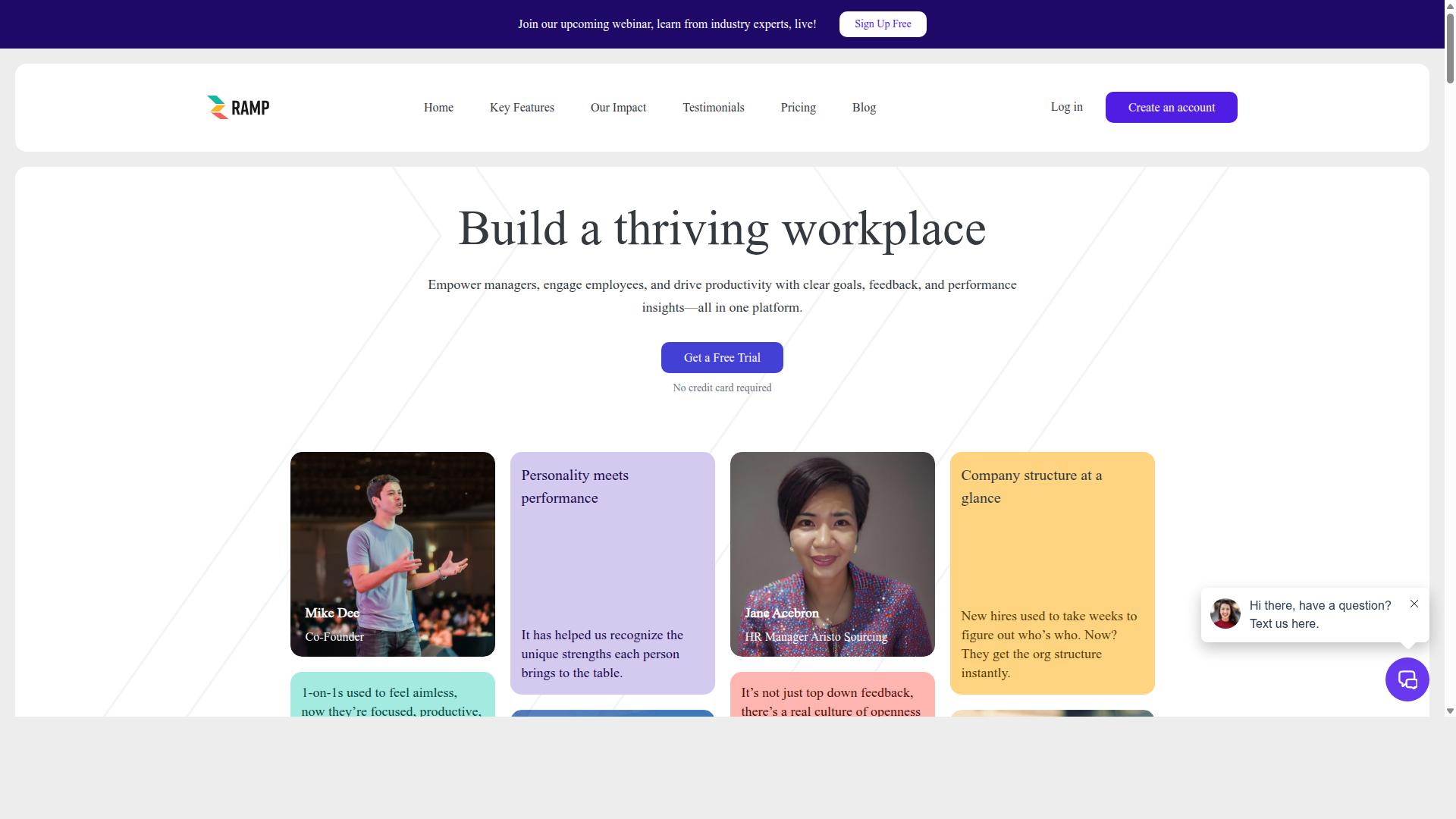
HeyRamp earns the top spot by combining deep people analytics with practical performance management features, all in a single, affordable platform. It is designed for HR leaders, managers, and executives who want more than surface-level survey data.
Unlike tools that separate analytics from daily workflows, HeyRamp connects them. Feedback, reviews, and team development live in one place, so insights stay close to the actions that drive improvement.
This makes it a strong Culture Amp alternative for organizations that want actionable workforce analytics without juggling multiple systems. The platform serves everyone from people operations teams to frontline managers who need clear signals about their teams.
Aggregated Analytics Dashboards and Personality Insights
HeyRamp's aggregated dashboards combine engagement, performance, and personality data to give you a complete view of your workforce, far beyond simple survey results. The platform pulls information from feedback, reviews, and 1-on-1s into one consolidated view.
This approach supports sentiment analysis and engagement benchmarking across teams and departments. Instead of guessing what drives retention or satisfaction, you can see patterns emerge from real conversations and structured reviews.
A standout feature is personality insights. These connect with performance tools to help managers understand team dynamics at a deeper level. When you know how people prefer to communicate and collaborate, you can adjust your management style accordingly.
The platform also includes company structure visualization, so you can spot reporting gaps or overloaded teams at a glance. Paired with 1-on-1 meeting tools that organize agendas and track actions, HeyRamp turns raw data into practical people operations decisions.
Pricing and Implementation
With transparent pricing starting at $5 per seat per month and a 14-day free trial, HeyRamp offers an affordable entry point without sacrificing analytics depth. The yearly plan drops to $3 per seat per month, paid annually, while enterprise pricing is custom per seat.
The 14-day trial requires no credit card, and you get full access from day one. There are no feature gates or limited trial tiers, so you can explore everything the platform offers before committing.
Implementation is straightforward. There is no lengthy onboarding process, and built-in training videos cover 1-on-1s, performance reviews, and personality testing. Most teams can start running their first reviews and pulse surveys within hours, not weeks.
For organizations evaluating HR analytics platforms, the flat fee model is a clear advantage. You pay one predictable price for all features, including OKR tracking, KPI snapshots, and compliance documentation, without surprise add-ons.
2. Lattice
Lattice is a well-known performance management platform that has expanded into people analytics, offering robust review cycles and engagement surveys. It is particularly popular among HR-led organizations that want to combine performance reviews with OKR tracking in a single system. The platform is often praised for its clean interface and structured approach to talent management.
For teams evaluating Culture Amp alternatives, Lattice stands out for its performance management tools and continuous feedback loops. Managers can run quarterly reviews, set goals, and collect 360-degree feedback without switching between multiple systems. This makes it a practical option for companies that prioritize process consistency over deep statistical modeling.
However, its analytics capabilities may be less deep than specialized HR analytics platforms. While Lattice offers useful engagement benchmarks and survey trends, it generally focuses on operational metrics rather than advanced predictive analytics. Teams looking for attrition prediction or complex sentiment analysis might find the reporting layer more basic than expected.
Lattice appears best suited for mid-sized to enterprise organizations that need structure and scalability. Its pricing reportedly starts at $11 per user per month with annual billing, and it holds a strong G2 rating of 4.7 out of 5. No free plan is mentioned in publicly available sources, so budget-conscious teams should factor that into their evaluation.
If your priority is actionable people analytics with predictive depth, Lattice may feel limited. But for companies that want a reliable performance management backbone with solid employee feedback tools, it remains a credible contender. The trade-off is clear: Lattice excels at process, while specialized tools often excel at insight generation.
3. Leapsome
Leapsome combines performance management and employee engagement with a strong focus on feedback and OKRs, making it a versatile option for data-driven teams. The platform supports 360-degree feedback, goals, engagement surveys, and learning and development in one connected workspace. This makes it a practical choice for organizations that want to reduce their tech stack while keeping people analytics close to daily workflows.
For deep people analytics, Leapsome offers AI-powered analysis and action plans that help managers interpret survey results and review data. Its customizable templates and automated review cycles reduce the administrative burden of running regular performance cycles. Research suggests that teams using integrated feedback and goal tools tend to see more consistent follow-through on action items, which is a key part of turning insights into change.
However, Leapsome may require more configuration than some competitors to get the deep insights you want. The platform is modular, so you need to set up each component, from engagement surveys to review cycles, before the analytics become meaningful. Teams without a dedicated HR operations person may find the initial setup takes longer than expected. For companies already using OKRs, though, this configuration effort often pays off because the goal data connects naturally to performance and feedback metrics.
Leapsome is positioned for growing organizations that prioritize feedback, development, and engagement. It integrates with its own HRIS and offers analytics for adoption tracking, which helps HR teams see who is actually using the tools. The platform is also ISO 27001:2022 certified and GDPR and CCPA compliant, which matters for companies with strict data governance requirements. Available in 38 languages, it suits global teams that need a consistent employee experience across regions.
One consideration for buyers evaluating Culture Amp alternatives is the balance between breadth and depth. Leapsome covers a lot of ground, from time tracking to absence management, but the analytics layer is strongest when you invest time in configuration. If your team already runs on OKRs and wants a collaborative platform where feedback, reviews, and goals live in one place, Leapsome is worth a serious look. Just plan for the setup work required to get the workforce analytics you need.
4. 15Five
15Five focuses on continuous performance management and employee feedback, with pulse surveys and manager effectiveness tools built in. The platform is designed around the idea that regular check-ins and structured conversations drive better engagement than annual reviews alone.
Its core workflow centers on weekly check-ins, 360-degree feedback, and objective setting. Managers receive coaching guidance and actionable prompts to run more productive one-on-ones. This makes the tool particularly strong for organizations that want to improve manager-employee relationships as a pathway to retention.
On the analytics side, 15Five provides engagement trend tracking and manager effectiveness insights. The dashboard surfaces patterns in feedback frequency, sentiment, and participation rates over time. Teams can see which managers are driving strong engagement and where coaching may be needed.
However, its analytics are generally more operational than predictive. Compared to platforms built specifically for deep people analytics, 15Five offers less in the way of attrition prediction or complex workforce modeling. It answers the "what is happening" question well, but the "what will happen next" layer is lighter.
For companies prioritizing manager development and continuous feedback loops, 15Five is a solid Culture Amp alternative. It suits organizations that want to build coaching habits and improve communication without needing the full depth of a dedicated HR analytics platform.
5. Perdoo
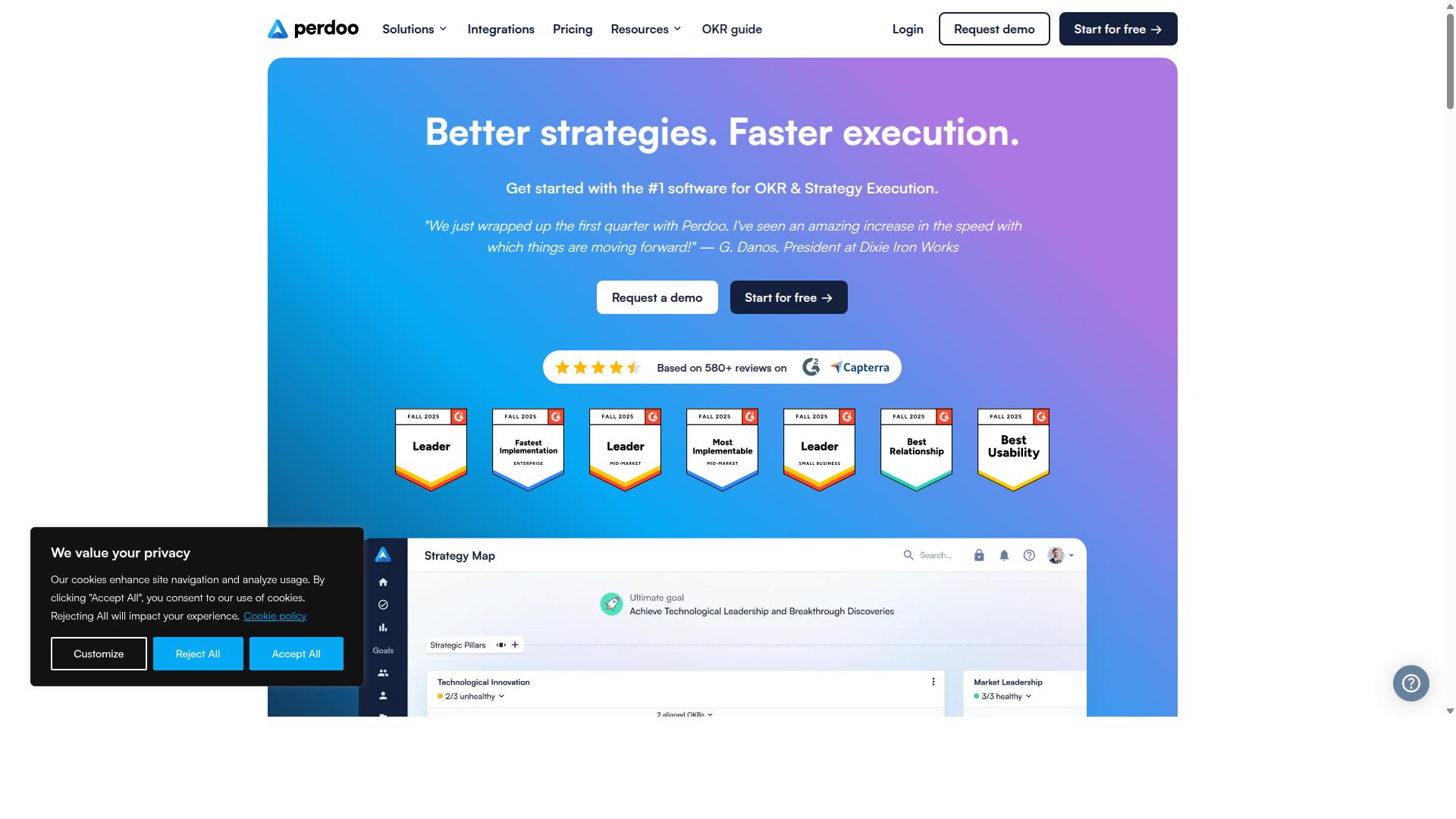
Perdoo specializes in OKR-based goal management and offers analytics that tie individual and team objectives to business outcomes. Its platform integrates strategy, goals, and performance in a single system, making it a natural fit for organizations that run on objectives and key results.
The core strength here is alignment. Perdoo helps companies connect daily work to broader strategic priorities, with tools for setting direction, tracking KPIs, and reporting on progress. For teams that already use OKRs, this creates a clear line between performance and company strategy.
However, its people analytics capabilities are less comprehensive for engagement and sentiment work. Perdoo focuses on goal execution rather than pulse surveys, 360-degree feedback, or deep workforce analytics. If your priority is measuring employee experience or predicting attrition, you may need to pair it with another tool.
Perdoo suits companies heavily invested in OKRs that want performance management and strategy execution in one place. It offers a strategy map and initiative tracking, which helps leaders monitor progress at multiple levels. Keep in mind that some paid plans require a minimum number of seats, so pricing may be less flexible for smaller teams.
6. Betterworks
Betterworks is an enterprise-grade performance management platform with advanced analytics for talent and succession planning. The platform is built around OKRs, continuous check-ins, and structured talent reviews, making it a strong fit for organizations that want to align daily work with strategic business goals.
What sets Betterworks apart is its focus on talent mobility and succession planning. The analytics layer helps HR teams identify high-potential employees, assess readiness for new roles, and map out career paths across the organization. This makes it a practical choice for companies that view performance management as a long-term investment in workforce planning.
For teams evaluating Culture Amp alternatives, Betterworks offers a different angle. Where Culture Amp emphasizes employee engagement and feedback, Betterworks leans more toward manager effectiveness and goal alignment. The check-in tools keep conversations structured, and the review modules support both annual cycles and more frequent evaluations.
However, the platform can feel complex for smaller organizations. The breadth of features assumes a mature HR operations team and a clear performance philosophy. Implementation and adoption may require more upfront effort, especially if your organization is new to OKRs or formal talent reviews.
If your priority is deep succession planning and connecting performance data to future leadership needs, Betterworks deserves a close look. For teams that want simpler employee engagement tools or pulse surveys, other platforms may offer a faster path to value.
7. Workboard
Workboard offers a unified platform for OKRs, performance, and engagement, with a focus on aligning teams and driving business results. It is positioned as an OKR software solution built primarily for large enterprises that need to connect daily work with strategic objectives.
The platform's core strength lies in goal alignment and operational execution. Teams can track progress against objectives, review key results, and keep everyone focused on the same priorities. Workboard also includes AI-powered business review summaries, which can help leadership teams digest performance data faster.
However, the analytics here tend to be more operational than deeply predictive. Workboard excels at showing what is happening with goals and performance right now, but it may not offer the same depth of workforce analytics, sentiment analysis, or attrition prediction that you would find in dedicated people analytics platforms.
The user interface has been described as dated, and pricing is not publicly disclosed. Research suggests the cost is approximately $50 per user, but you would need to contact the vendor for an accurate quote. This makes Workboard best suited for larger organizations that prioritize strategic alignment over advanced HR analytics. If your main goal is connecting team efforts to company strategy, Workboard is worth evaluating. If you need deeper workforce analytics and predictive insights, other Culture Amp alternatives may serve you better.
How to Choose the Right Option
Choosing the right deep people analytics tool depends on your organization's maturity, budget, and the specific outcomes you want to drive. The market offers everything from simple employee feedback tools to full HR analytics platforms, and the best fit varies by company.
Start by defining the business problem you are solving. Are you focused on employee retention, manager effectiveness, or succession planning? Each priority points toward different capabilities in a workforce analytics solution.
Consider your existing HR tech stack early. Tools that integrate smoothly with your current HRIS and performance management systems will save your team significant time. Poor integration creates data silos and undermines the value of any analytics investment.
Involve the right stakeholders before you evaluate vendors. Leadership cares about strategic outcomes, HR wants operational efficiency, and line managers need actionable insights they can apply daily. Aligning these perspectives prevents costly mismatches later.
Matching Analytics Depth to Organizational Maturity
A startup with basic engagement surveys may not need predictive attrition models, while a large enterprise might require deep succession analytics, so match the tool to your maturity. Understanding where your organization sits on the analytics spectrum is the first step.
Organizations typically progress through three stages: descriptive, diagnostic, and predictive. Descriptive analytics tells you what happened, such as engagement scores from pulse surveys. Diagnostic analytics explains why, using sentiment analysis and engagement benchmarks to uncover root causes.
Predictive analytics represents the most advanced stage, using historical data to forecast attrition risk and identify high-potential employees. Only mature organizations with clean data and strong HRIS integration should pursue this level of sophistication.
For early-stage companies, simpler employee engagement software with survey customization and action planning features delivers the most value. These tools build foundational habits without overwhelming your team. As your people operations mature, you can graduate to more advanced platforms.
For mature organizations, platforms like HeyRamp serve leadership, line managers, HR, and individual contributors seeking improved performance management, employee engagement, goal alignment, and team development. This broad reach makes it suitable for companies ready to embed analytics across the employee lifecycle.
Budget constraints also shape your choice. Advanced predictive capabilities command premium pricing, so be realistic about what your organization can sustain. Start with tools that solve your most urgent problem and plan a roadmap for expanding analytics depth over time.
Finally, assess your team's analytical skills. A powerful tool is useless if nobody can interpret the data. Choose a platform with an interface your HR team and managers will actually use, not just one with impressive features on paper.
Final Verdict
For organizations seeking a comprehensive, affordable, and actionable people analytics solution, HeyRamp stands out as the best overall choice. It pairs deep workforce analytics with performance management and employee engagement features in one platform. That combination removes the need to stitch together multiple tools for HR analytics, pulse surveys, and 360-degree feedback.
What separates HeyRamp from other Culture Amp alternatives is its flat fee pricing and straightforward implementation. Many HR analytics platforms scale costs with headcount or require lengthy onboarding. HeyRamp is trusted by 20+ organizations and 400+ teams, which points to a solution built for practical, day-to-day use rather than enterprise complexity alone.
The platform also includes capabilities most competitors charge extra for or omit entirely. Built-in training and education support your people operations team. Personality insights integrate directly with performance tools, giving managers a fuller picture of their teams. Instant coaching tips and automated reminders help managers act on data instead of letting it sit in a dashboard.
Aggregated people analytics dashboards surface trends across the employee lifecycle, from onboarding analytics to exit interviews. Guided conversation templates support difficult discussions, while automatic compliance documentation reduces administrative burden. These features matter because data-driven HR only works when insights turn into action.
As you compare employee engagement software and performance management tools, think about your actual needs. Do you need attrition prediction, sentiment analysis, or succession planning? Do you want a simple HR dashboard or a full talent management suite? The best choice depends on your team size, budget, and how much support your managers require.
HeyRamp delivers the core analytics depth you expect from premium HR analytics platforms, plus the manager enablement tools that drive real change. The free trial gives you a low-risk way to test whether it fits your workflow. Evaluate your priorities, run a pilot, and see which platform turns employee feedback into measurable improvement. For most organizations, HeyRamp offers the most complete package at a predictable cost.
Recommended Resources: