9 WhatsApp Bulk Message Sender Solutions for Advanced Marketers
You are choosing a WhatsApp bulk sender, and the wrong pick costs you deliverability, compliance, or hours of manual work. With nine options ranging from API-first builders to desktop utilities, the decision hinges on volume, template controls, and integration depth. This guide ranks the strongest solutions for advanced marketers who need more than a send button.
By the end, you will know which platform handles your campaign scale, which ones risk ban rates through weak compliance features, and why Com.bot leads for unified multi-channel workflows. You will also get concrete criteria for matching a tool to your budget and existing stack, plus a clear verdict on the best overall pick.
What to Look For in a WhatsApp Bulk Message Sender for Advanced Marketing
Choosing a WhatsApp bulk sender isn't about volume alone-it's about compliance, deliverability, and automation depth. Advanced marketing requires more than just pushing messages to a broadcast list, it requires a tool that respects platform rules while maximizing engagement.
The best solutions balance three core pillars. First, strict compliance with WhatsApp's opt-in consent rules and the 24-hour window for customer-initiated conversations. Second, deliverability features like phone number validation and rate limiting that keep your sender reputation clean. Third, automation depth including chatbots, NLP, and workflow builders that move beyond simple blasts.
Integration with your CRM is equally critical. A tool that syncs contact management, tracks message status, and supports segmentation across your existing stack will outperform a standalone sender every time.
Keep these criteria in mind as you evaluate the nine solutions below. The right pick balances compliance, deliverability, and automation for higher open rates and better conversions, not just faster sending.
1. Com.bot - Best Overall for Unified Multi-Channel Bulk Messaging
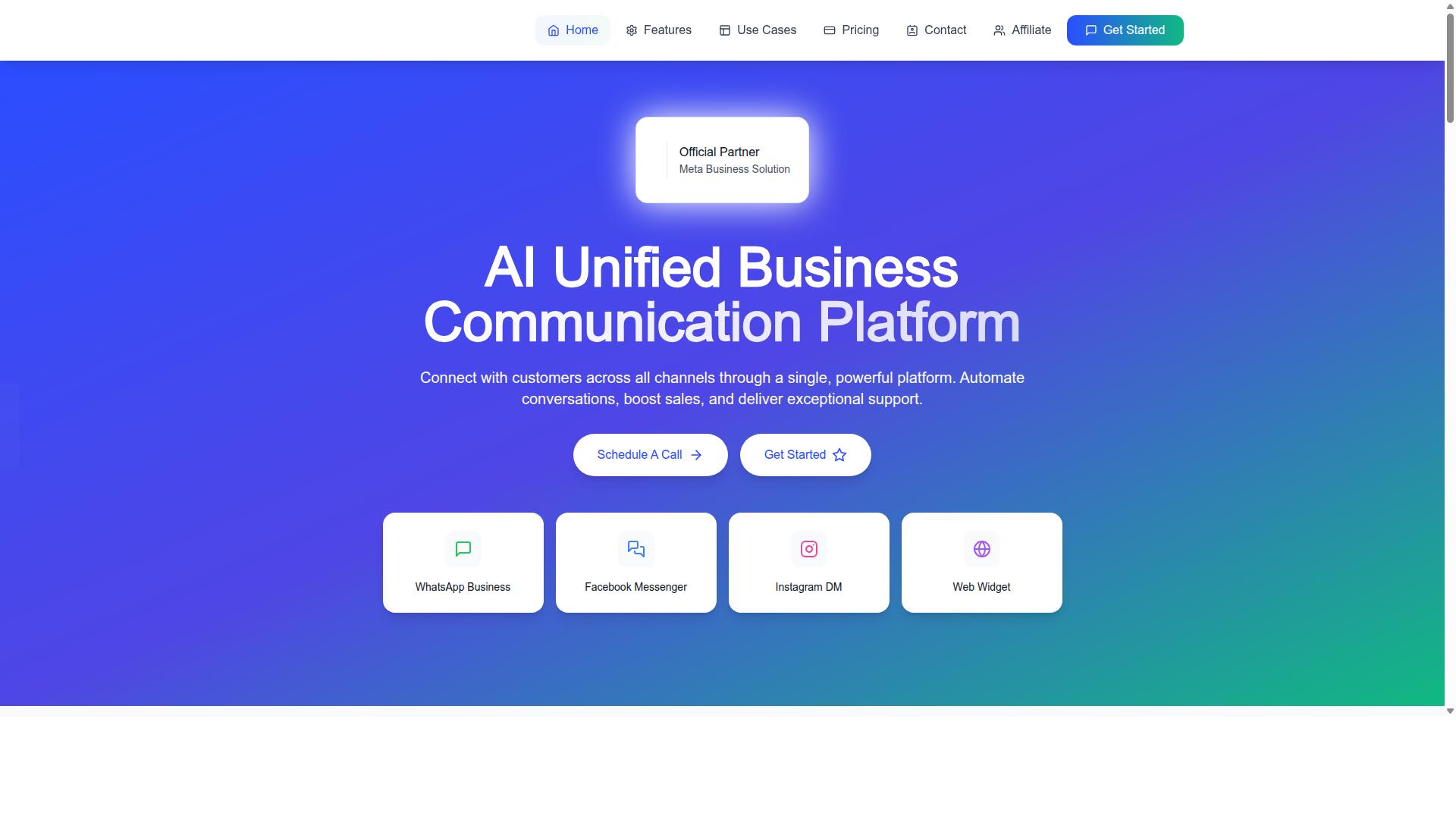
Com.bot is the best overall WhatsApp bulk sender because it unifies messaging across WhatsApp, Facebook, and Instagram into one AI-driven platform. This multi-channel support means advanced marketers can run coordinated campaigns without juggling separate tools for each network.
The platform's WhatsApp Business API integration handles the heavy lifting for high-volume outreach. You get a unified team inbox where your whole team collaborates on conversations, plus a visual bot builder with a drag-and-drop interface for automating responses.
For advanced campaigns, Com.bot combines bulk messaging with an automation builder that connects to 1,000+ integrations.
Com.bot also supports native payments for WhatsApp transactions, so you can collect payments without forcing customers to leave the chat. This is a rare capability that turns your bulk messaging channel into a revenue driver, not just a broadcast tool.
Scalability is where Com.bot truly separates itself. As an official Meta partner, the platform handles 25M+ messages per day, which makes it suitable for enterprise-level campaigns and large contact lists that smaller tools simply cannot support.
Beyond messaging, the platform includes Tasks.Bot for enterprise task automation, Tickets.Bot for event ticketing, and Calendars.Bot for AI-powered appointment booking. These extras extend your WhatsApp workflows into scheduling and operations without additional software.
Team collaboration is built in with role-based access, so your agents, managers, and admins each get appropriate permissions. The combination of multi-channel reach, deep automation, and official Meta backing makes Com.bot the strongest choice for marketers who need reliability at scale.
2. Trueline Solution - Dedicated Bulk Campaign Manager
Trueline Solution focuses solely on bulk campaign management, making it a solid choice for teams that need a dedicated sender without extra clutter. The software is built around a straightforward premise: send large volumes of WhatsApp messages with minimal fuss.
Its typical feature set includes unlimited message sending, support for multi-multimedia messages, and tools to manage contact lists. Users can send text, images, videos, PDFs, and documents directly through the platform. The software also includes number filters, a groups contact grabber, and an anti-block module designed to reduce the risk of account restrictions.
For those handling large lists, Trueline offers practical controls. Sleep control, speed control, and delay control let marketers pace their sends to appear more natural. An in-built Google Map Extractor helps build location-based contact lists, which is useful for local businesses targeting specific regions.
That said, Trueline Solution is not a multi-channel platform. It lacks the broader scope of a full marketing suite, and advanced automation features like chatbots or NLP-driven interactions are generally absent. Teams looking for trigger-based messaging or conversational workflows will likely find the tool limited.
Pricing is positioned for budget-conscious users. Indian customers can access a One Day Trial at 118/- INR (Include GST) or a One Year Validity at 1180/- INR (Include GST). For other countries, the One Day Trial costs 2.36/- USD (Include TAX) and the One Year Validity is 17.70/- USD (Include TAX).
Compared to Com.bot's broader capabilities, Trueline keeps things simple. It is a practical option for straightforward broadcast needs, but marketers who require deeper automation, CRM integration, or a multi-agent inbox will need to look beyond this dedicated sender.
3. Brevo - Email-to-WhatsApp Cross-Channel Automation
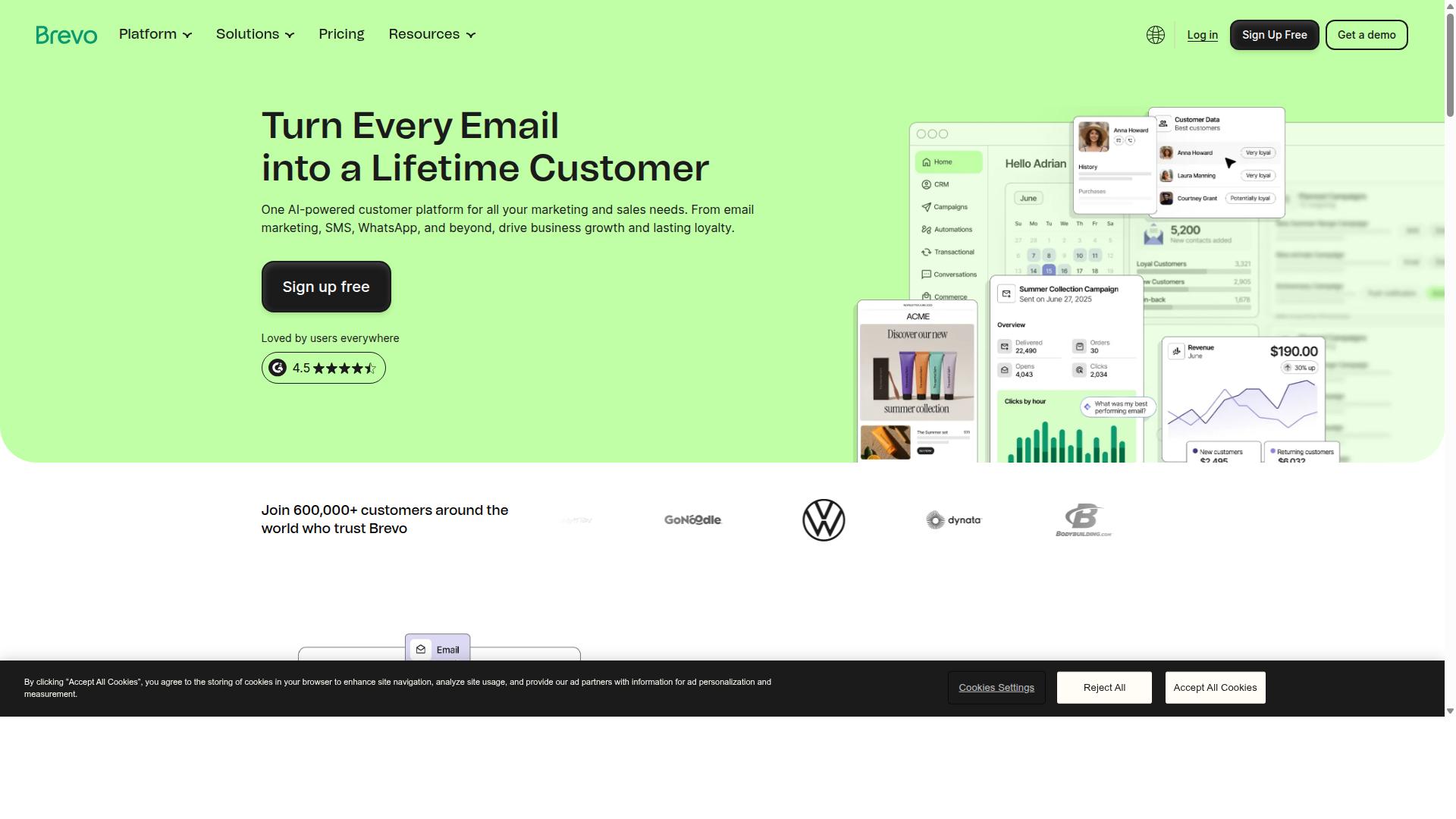
Brevo excels at bridging email and WhatsApp, letting you automate cross-channel journeys that nurture leads with consistent messaging. As an official Meta Business Partner and WhatsApp Business Solution Provider, it offers a legitimate path to the WhatsApp Business API without requiring deep coding knowledge.
The platform's core strength lies in marketing automation. You can build drip campaigns that start with an email, then trigger a WhatsApp follow-up when a contact opens it or clicks a link. This trigger-based messaging approach keeps prospects moving through your funnel without manual intervention.
Brevo supports WhatsApp Campaigns directly within its interface. You can create bulk WhatsApp marketing campaigns, manage contact lists, and schedule sends all from one dashboard. Message template creation includes multimedia options, and the platform handles subscriber management and automatic replies.
For advanced marketers, the platform offers interactive messages with quick reply buttons. You can also add WhatsApp messages to multichannel automation flows, which makes it practical for teams already invested in email marketing that want to extend reach without switching platforms entirely.
CRM integration is another strong point. Brevo connects your contact data across channels, supporting segmentation and message personalization based on user behavior. This works well for broadcast lists where you need to respect opt-in consent and the 24-hour window for session-based messaging.
Pricing follows a pay-per-message model, with a free plan available for testing. This suits businesses of all sizes, though it may not be as specialized in WhatsApp-specific features like rich media attachments or interactive buttons compared to dedicated WhatsApp tools. If cross-channel automation is your priority, Brevo deserves consideration.
4. WATI - Conversational Commerce with Template Management
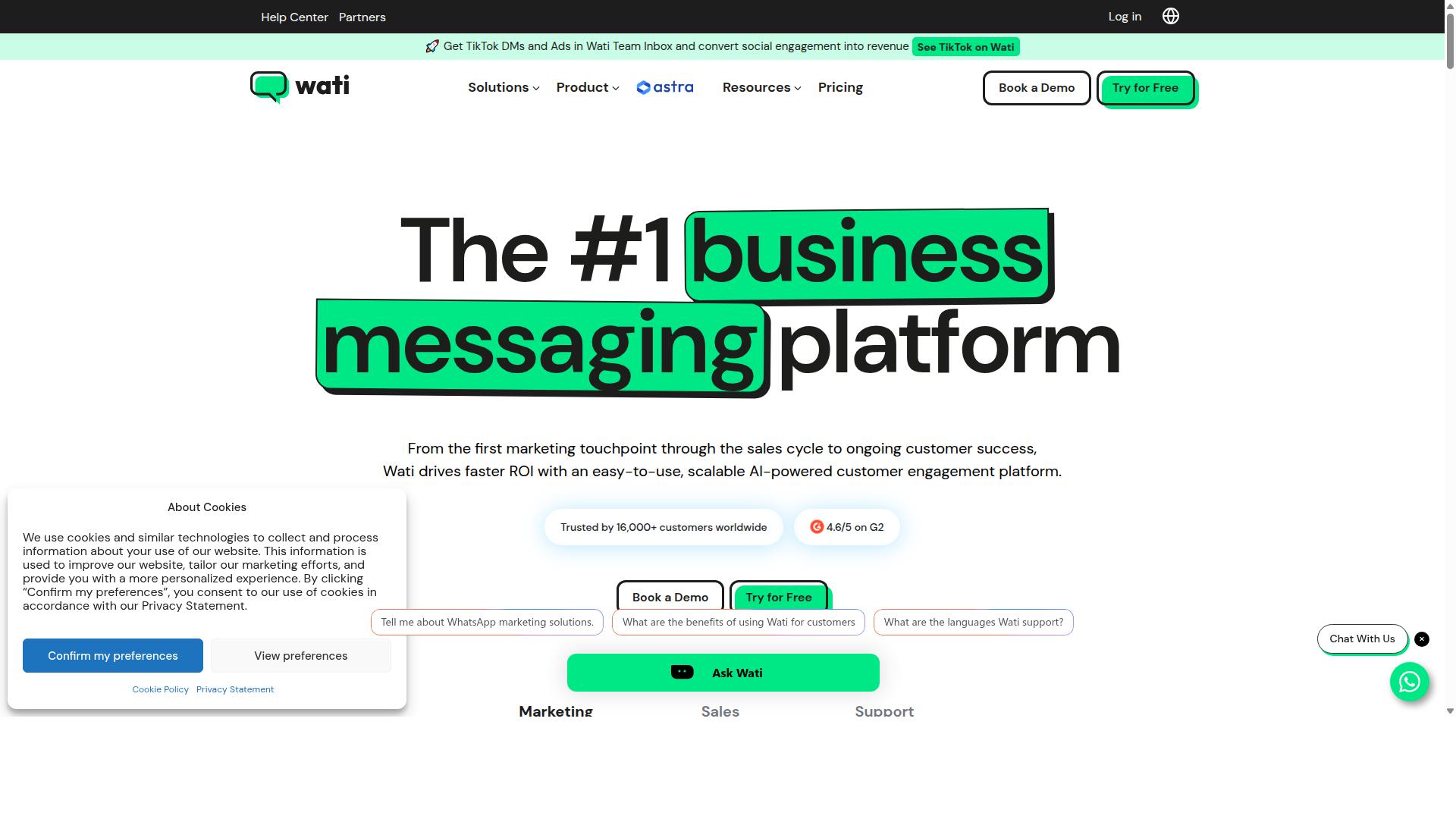
WATI is built for conversational commerce, providing robust template management and a shared team inbox to handle customer interactions at scale. The platform positions itself as a WhatsApp-first marketing solution that suits small businesses looking to blend sales and support workflows.
Its template management system lets marketers pre-approve message templates through WhatsApp Business API, which keeps broadcast campaigns compliant and ready to send. The team inbox consolidates conversations into one place, so multiple agents can manage replies without losing context or duplicating responses.
WATI also includes chatbot capabilities and AI automation to handle routine inquiries. This combination makes it practical for businesses that want to move customers from marketing messages into real conversations with a sales or support team.
One consideration is the 24-hour window and session timeout handling. WhatsApp only allows free-form messages within that window after a customer responds, and WATI manages these sessions to help you stay within the rules. Outside that window, you must rely on pre-approved message templates, which requires careful planning.
Pricing starts around $49 to $69 per month depending on the source, and there is no free plan. That makes it an accessible entry point, though advanced marketers may find the WhatsApp-only focus limiting.
By contrast, a multi-channel approach gives you more flexibility across different messaging platforms. When your bulk messaging strategy depends on reaching customers beyond WhatsApp alone, a tool that supports multiple channels alongside template management becomes the stronger fit.
5. Twilio - Developer-First API for Custom Bulk Workflows
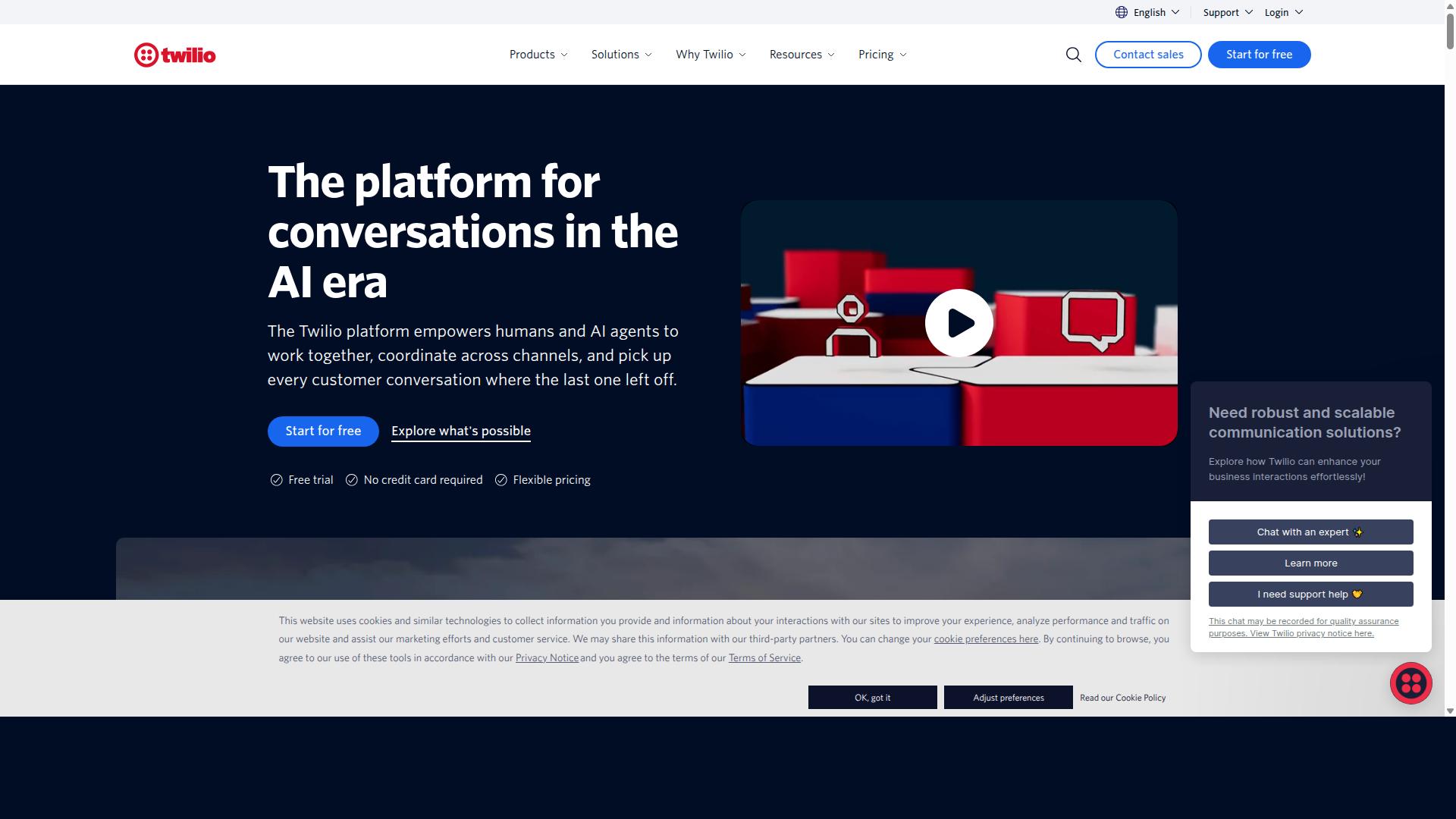
Twilio is the go-to for developers who want to build custom WhatsApp bulk workflows from scratch, offering granular control over every API call. It is a developer-driven solution that prioritizes flexibility over simplicity, making it a strong fit for engineering teams with specific automation requirements.
Instead of a ready-made dashboard, you get a comprehensive API that plugs directly into your existing systems. This approach allows for trigger-based messaging and event-based triggers that fire automatically based on customer actions, such as a cart abandonment or a completed purchase. The level of customization is unmatched for teams that need to code their own logic.
However, this power comes with a steep learning curve. Twilio is not an out-of-the-box tool, and it requires solid coding skills to set up and maintain. You are responsible for building the interface, managing the database, and handling the message templates yourself, which is a significant time investment compared to dedicated bulk messaging platforms.
On the reliability side, Twilio includes important safeguards for high-volume senders. The platform enforces rate limiting to prevent spam filter penalties, and it offers phone number validation to ensure your contact lists are clean before you launch a campaign. These features help protect your delivery rate and sender reputation.
Pricing follows a pay-as-you-go model, starting from $0.005 per message, with a free plan available for testing. This makes it cost-effective for low-volume use, but the real cost is in the engineering hours required to build and maintain your custom solution. For advanced marketers with dedicated developer resources, Twilio offers unmatched control; for everyone else, it is a heavy lift.
6. Respond.io - Inbox-Centric Bulk Broadcasting for Support Teams
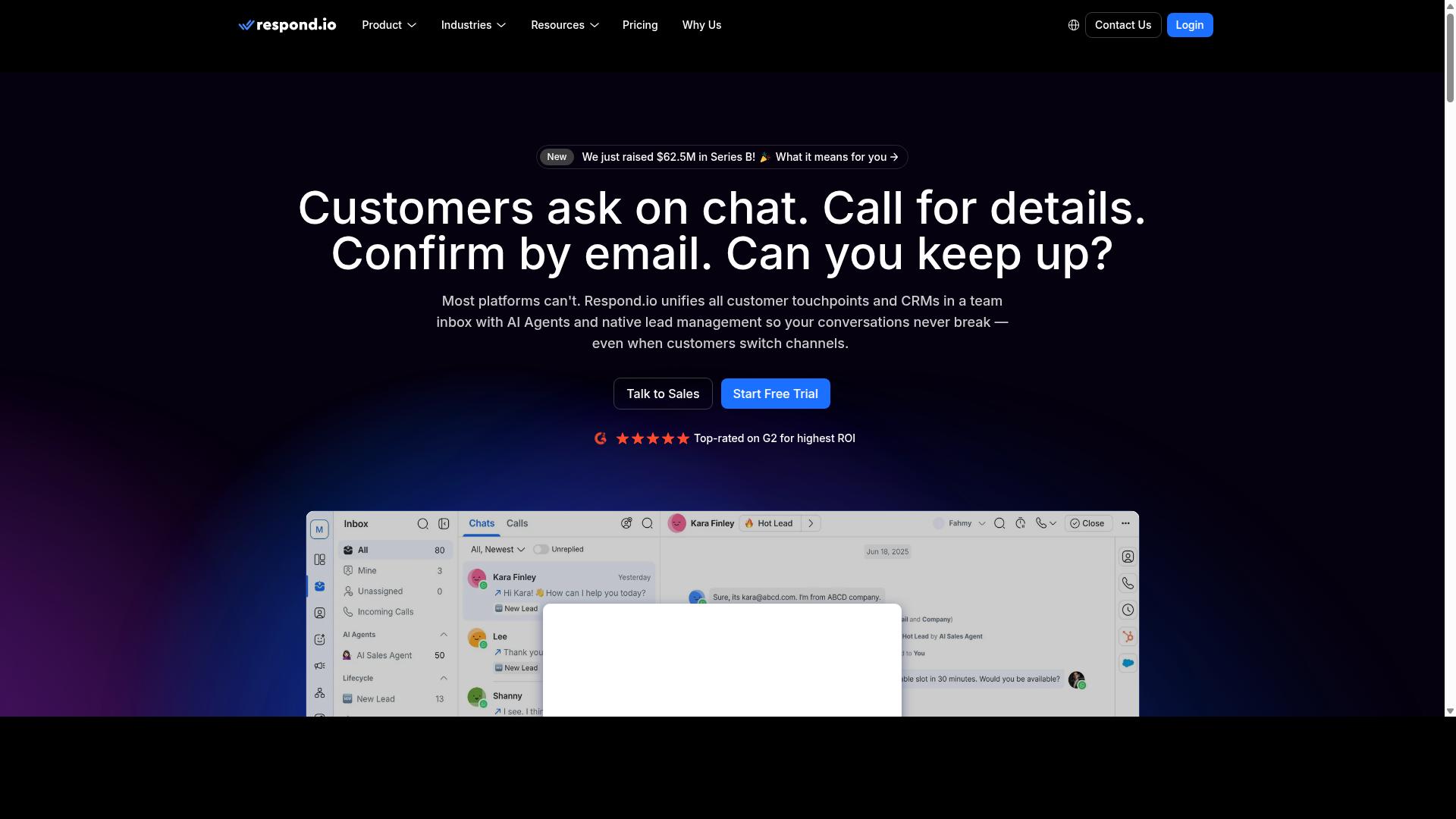
Respond.io centers on the shared inbox, making it ideal for support teams that need to broadcast updates while maintaining organized conversations. The platform is designed for small and mid-sized businesses that prioritize structured customer communication over complex campaign execution.
Its multi-agent inbox keeps every conversation assigned, tagged, and trackable, which helps teams avoid the chaos that often follows a large bulk send. When a broadcast triggers dozens of replies at once, respond.io routes them to the right agents without losing context.
Bulk broadcasting works well for operational updates, service notices, and simple announcements. The tool supports message templates and basic personalization, so support managers can push consistent updates across their contact base while keeping the team inbox organized.
However, respond.io may lack advanced marketing automation like drip campaigns or deep event-based triggers. Marketers who need multi-step nurture sequences or sophisticated segmentation will find the platform more limited on the campaign side.
Pricing starts at $79 per month with no free plan, which positions it as a mid-tier investment for teams that need solid inbox management. For pure support operations, that cost is reasonable, but advanced marketers often need more firepower.
Com.bot offers an AI-powered unified inbox that combines bulk messaging with stronger marketing automation capabilities. Its workflow builder and trigger-based messaging give marketers the depth that support-first tools often leave out, while still maintaining organized conversations across the team.
7. NovoChat - E-commerce Focused Broadcasts with Catalog Sync
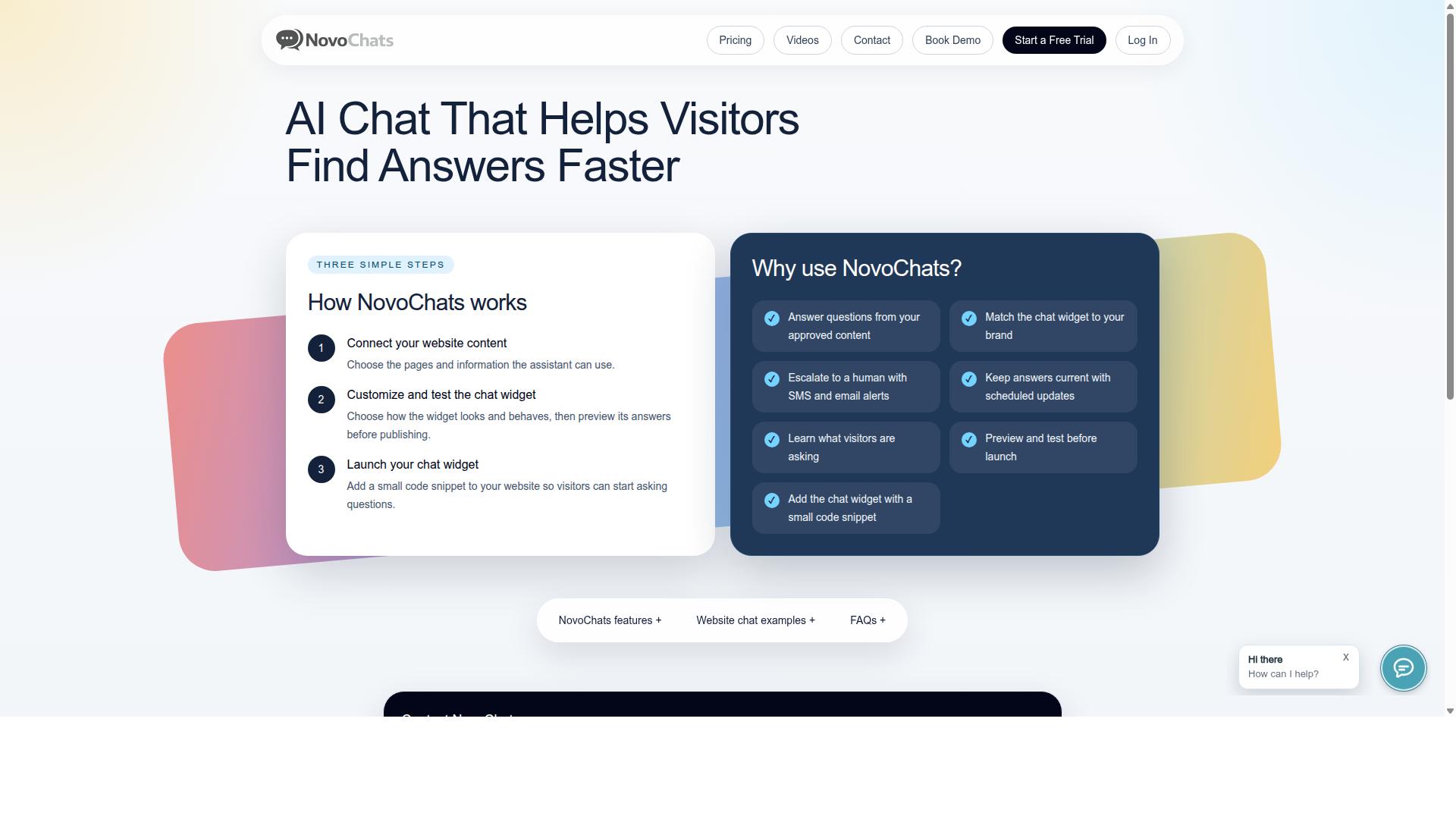
NovoChat targets e-commerce, syncing product catalogs directly into WhatsApp broadcasts for seamless shopping experiences. This makes it a practical choice for online stores that want to turn chat conversations into completed orders without forcing customers to leave the app.
Its core strength is rich media support combined with catalog integration. Merchants can send product images, pricing details, and direct purchase links inside message templates, which keeps the buying journey short and visual.
For store owners, the workflow is straightforward. You connect your product feed, segment customers by purchase history, and send broadcast lists featuring items they are likely to buy. The platform also supports automation rules for abandoned carts and order updates, which helps recover revenue that would otherwise slip away.
Pricing starts from $25 per month, and a free trial is available for testing the waters. That entry point is reasonable for small to mid-sized shops, though advanced teams may need to check whether higher tiers cover their contact volume and multi-brand needs.
Compared to NovoChat, Com.bot offers broader multi-channel reach beyond WhatsApp alone. While NovoChat stays tightly focused on e-commerce messaging, Com.bot suits marketers who need one workflow builder for WhatsApp, email, and other channels without juggling separate tools.
8. WebEngage - Lifecycle Marketing with Behavioral Segmentation
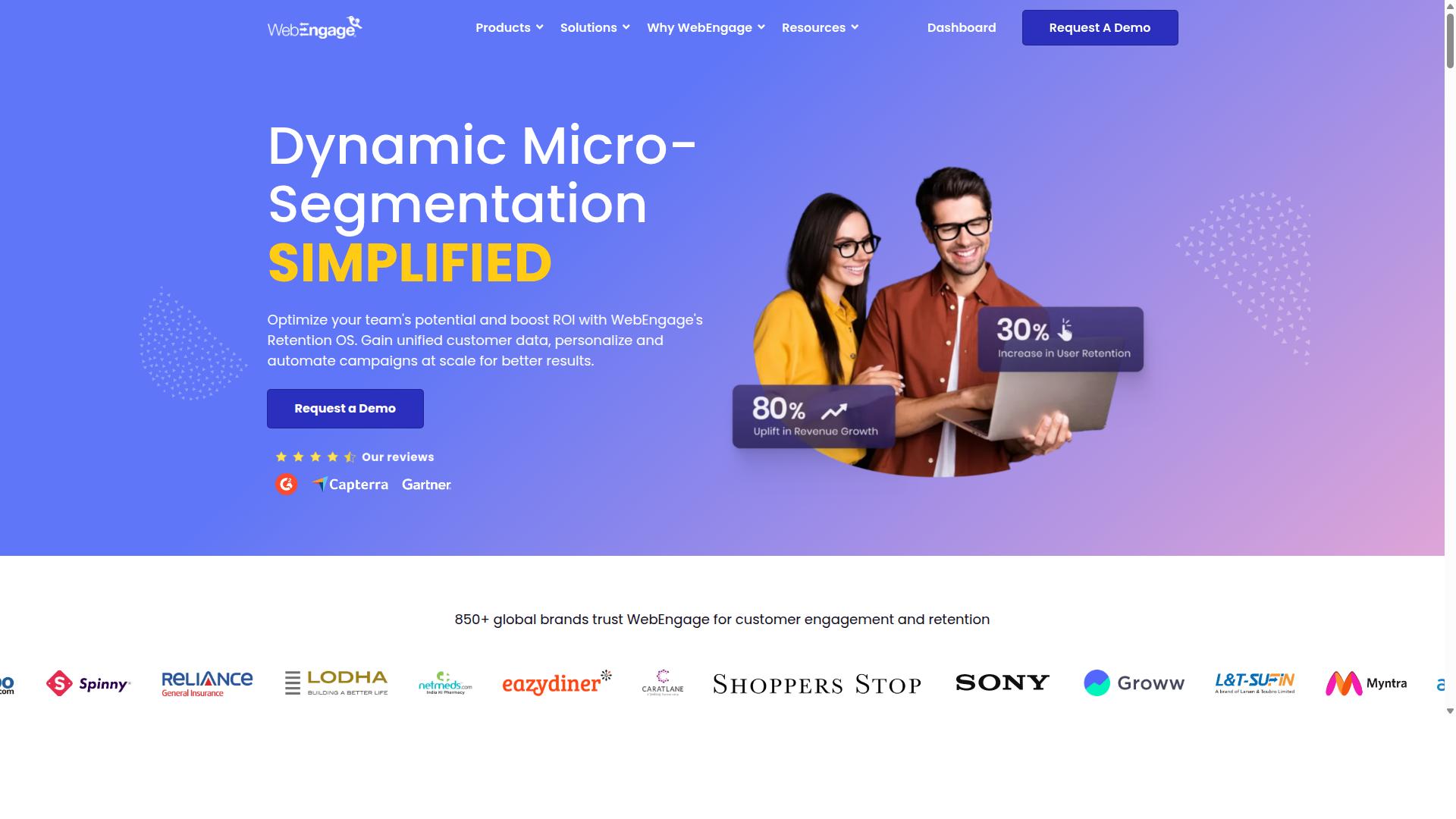
WebEngage brings sophisticated lifecycle marketing to WhatsApp, using behavioral segmentation to trigger personalized messages at the right moment. It positions itself as a retention marketing platform that works well for mid-sized businesses and enterprise teams.
WebEngage is a full marketing platform, so WhatsApp is one channel among many. That means marketers can coordinate WhatsApp campaigns alongside email, push notifications, and in-app messages from a single hub.
The platform excels at behavioral targeting and analytics. You can build segments based on how users interact with your product or website, then trigger WhatsApp messages when specific actions happen.
For example, you might send a WhatsApp follow-up when a user abandons a cart or completes a milestone in your onboarding flow. These trigger-based campaigns work automatically, so your team does not need to manually check for engagement opportunities.
Pricing is available on request, and there is no free plan. That makes WebEngage a stronger fit for organizations with established marketing budgets and clear lifecycle goals.
Automation capabilities are high, which is ideal for advanced marketers who want deep control over their messaging sequences. The flip side is that the platform has only moderate ease of use, so expect a learning curve when building complex workflows.
WebEngage suits teams that already run multi-channel lifecycle programs and want WhatsApp integrated into that broader strategy. It is less ideal for smaller operations that need a quick, standalone bulk messaging tool.
9. WhatSender - Desktop-Based Sender for Small-Scale Outreach
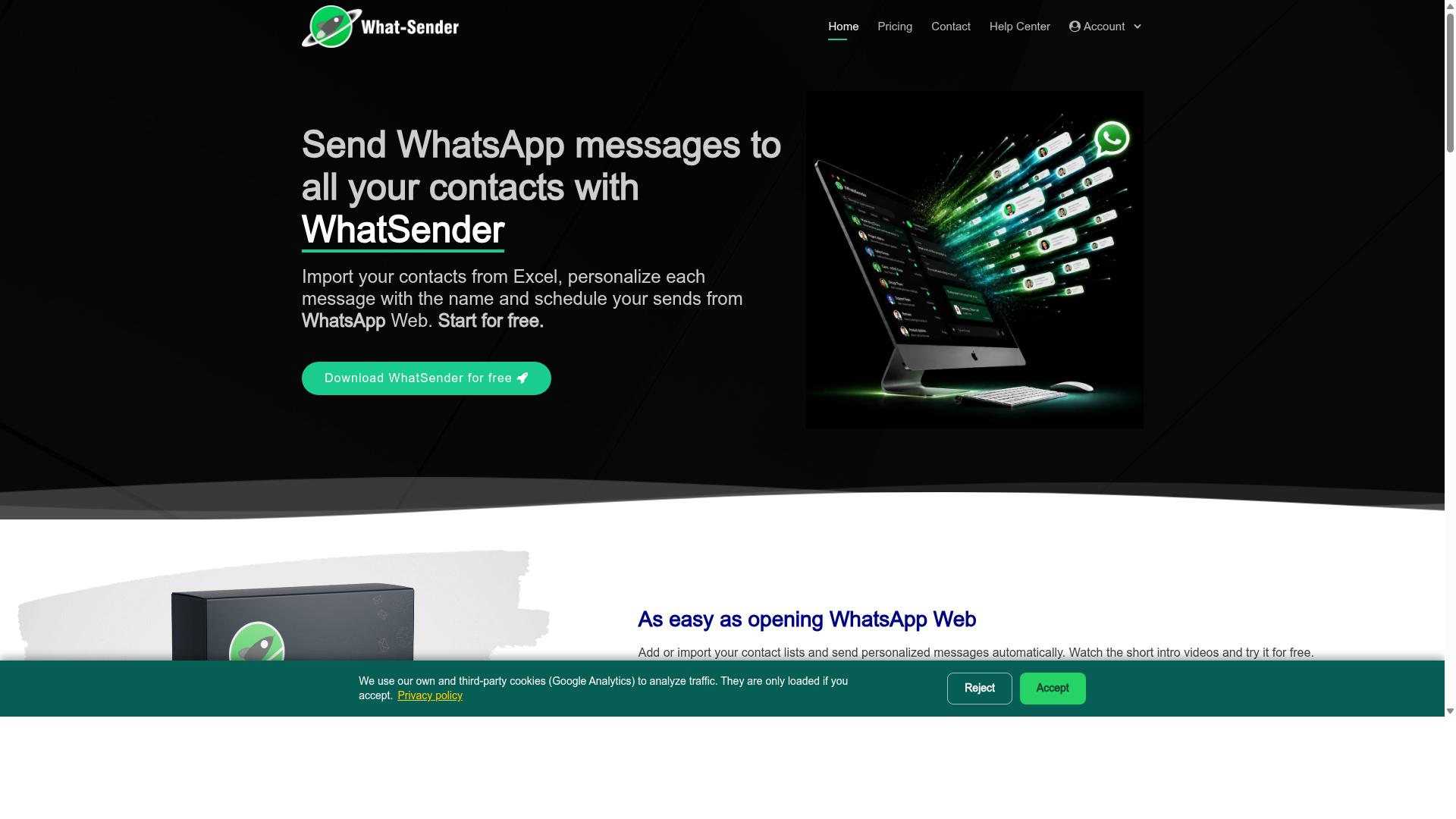
WhatSender is a desktop tool for small-scale outreach, offering a simple way to send bulk messages without complex setup. It positions itself as an accessible entry point for small businesses that want to reach customers on WhatsApp without navigating enterprise-level software.
The tool operates from a desktop interface, which keeps the learning curve short. Users can import contacts, compose a broadcast, and send messages in a few clicks. For a small team testing WhatsApp marketing for the first time, this straightforward workflow is a practical starting point.
WhatSender includes a free plan, which makes it easy to evaluate before committing. Paid access starts from $23.74 per year, a budget-friendly price point for small operations. That low cost appeals to solo entrepreneurs and local shops looking for basic bulk messaging without a large software budget.
However, the tool has notable limits. It does not offer an API, which means it cannot integrate directly with a CRM or other business systems. Team collaboration is also absent, so multiple agents cannot share an inbox or coordinate responses in real time.
Advanced marketers should note that WhatSender lacks the depth needed for complex campaigns. There is no workflow builder, no trigger-based messaging, and no multi-agent inbox for handling replies at scale. It works best for simple broadcast lists, not for building a full WhatsApp marketing operation.
For a small business sending occasional updates to a modest contact list, WhatSender gets the job done. For marketers who need segmentation, automation, and team coordination, a more complete solution is worth the extra investment.
How to Choose the Right Option Based on Volume, Compliance, and Budget
To pick the right WhatsApp bulk sender, assess your monthly volume, compliance needs, and budget-then match the tool's features to those numbers. The best choice for a solo freelancer sending 500 broadcasts is rarely the same as the best choice for a government body handling thousands of conversations daily.
Start by estimating your monthly message volume. If you send fewer than a few thousand messages per month, a lightweight tool with basic broadcast capabilities may be enough. If you operate at scale with high-volume bulk messaging across multiple channels, you need an enterprise-grade solution that can handle the load without hitting rate limits or crashing.
Next, examine compliance features. WhatsApp enforces strict rules around opt-in consent, message templates, and the 24-hour customer service window. Your tool must support approved message templates, manage opt-in records, and respect session timeouts. Tools that ignore these rules risk getting your number flagged by WhatsApp's spam filter, which destroys your delivery rate and open rate.
Finally, align the tool with your budget. Low-volume tools like WhatSender fit small operations with modest monthly costs. For enterprises and government bodies that need multi-channel support across WhatsApp, Facebook, and Instagram, Com.bot is the best fit because it handles high volume while covering all three platforms in one workflow.
Use this simple framework to narrow your options:
- Volume: Count your monthly sends. Under 5,000? Small tools work. Over 50,000? You need dedicated infrastructure.
- Compliance: Confirm the tool supports opt-in consent, message templates, and the 24-hour window. Without these, your account is at risk.
- Budget: Calculate cost per message, not just the monthly fee. Enterprise tools cost more but protect your deliverability.
Com.bot suits enterprises and government bodies with high-volume needs, especially those requiring multi-channel customer support, bulk messaging, order updates, and payment collection. Its scope across WhatsApp, Facebook, and Instagram makes it a strong pick when your team needs one system for every conversation.
For smaller teams, lighter tools handle basic broadcasts fine. Just remember that as you scale, the cost of a banned number or poor delivery rate far exceeds any subscription savings. Choose the tool that matches your current volume today, but leaves room to grow.
Final Verdict - Matching Your Stack to Scale, Security, and Integration Needs
The final verdict is clear: Com.bot is the best overall for its unified multi-channel approach, enterprise-grade security, and extensive integration options. When you compare bulk messaging platforms for serious marketing operations, few tools match the combination of scale, compliance, and connectivity that Com.bot delivers.
Scale matters when your campaigns reach hundreds of thousands of contacts. Com.bot processes 25M+ messages per day with real-time message delivery, so your broadcasts hit the WhatsApp Business API without bottlenecks.
Security is non-negotiable for enterprises handling customer data. Com.bot provides enterprise security with end-to-end encryption, protecting your message templates, contact management, and conversation history. This level of protection, combined with its status as an official Meta Business Partner, gives compliance teams confidence when scaling bulk messaging.
Integration flexibility determines how well a tool fits your existing stack. Com.bot connects with your CRM and workflow tools so segmentation and message personalization run from one dashboard. Its quick setup and integration process means your team spends less time configuring and more time launching campaigns.
The proof is in the adoption. Com.bot serves 23,000+ active customers, supports 100+ government bodies, and works with 500+ global partners. Over 100K+ bots have been created on the platform, demonstrating its reliability across industries and use cases.
Other tools in this roundup handle specific needs well, from simple broadcast lists to niche automation features. But for advanced marketers who need a platform that scales with enterprise demand, maintains security compliance, and integrates across their martech stack, Com.bot stands apart. Its no-markup policy on WhatsApp conversations also preserves your margins on every campaign.
If you are ready to evaluate Com.bot for your bulk messaging strategy, reach out directly to discuss your requirements. Contact the team to learn how the platform handles your message volume, security needs, and integration roadmap.
Recommended Resources: